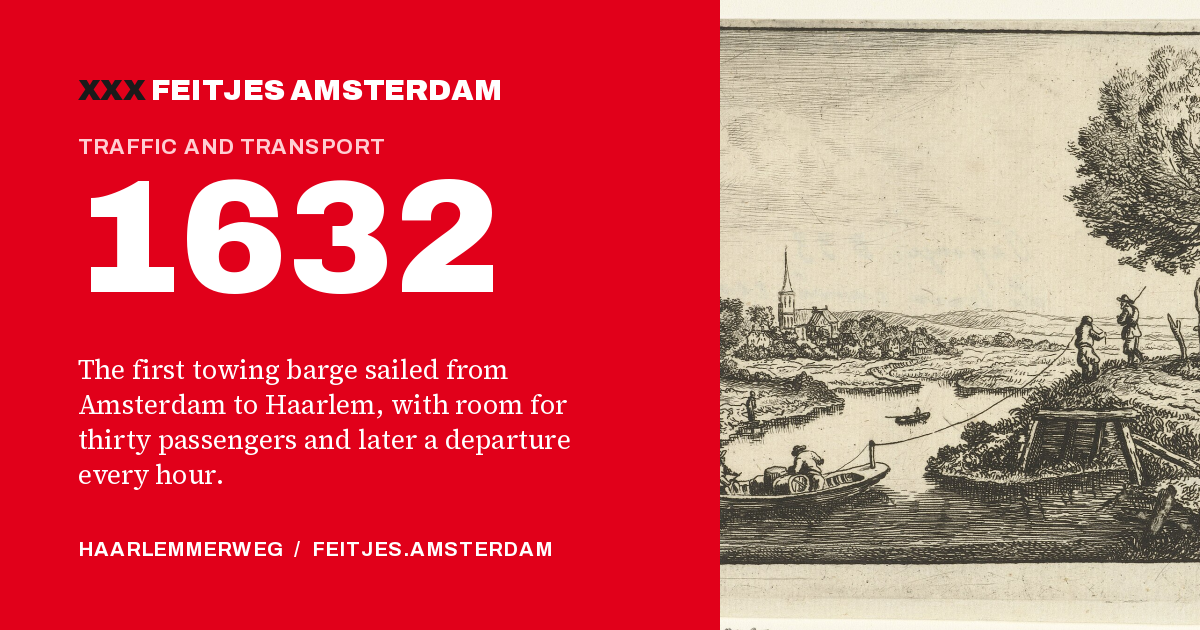
Travelling between Amsterdam and Haarlem in the early seventeenth century was a hassle. You went along a winding dyke, by cart or on foot, or by a boat at the mercy of the wind. In 1631 the two cities decided to build something new together: a dead-straight canal with a path alongside, on which a horse could pull a barge. A year later, in 1632, the first towing barge set off, with room for thirty passengers.
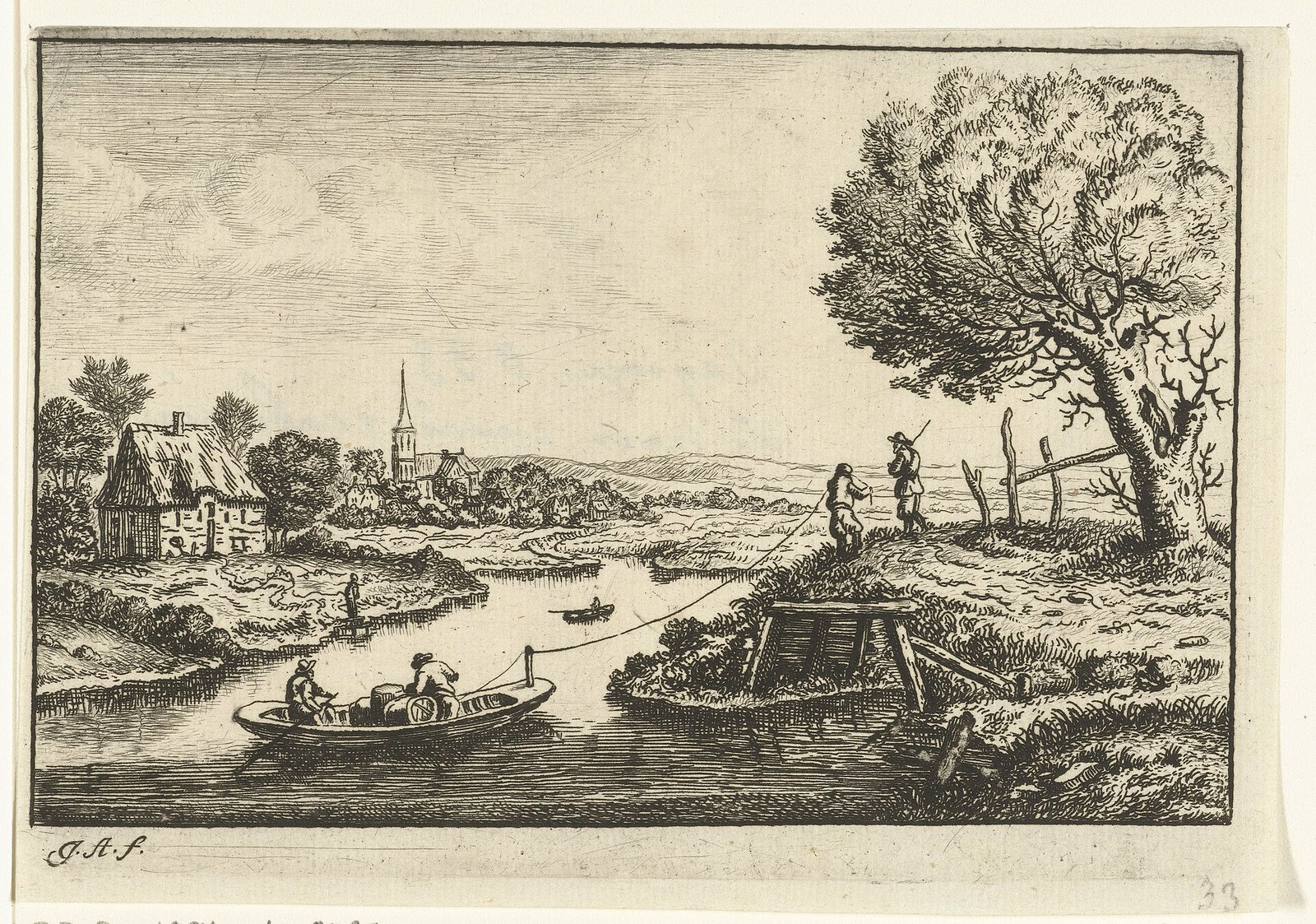
A horse, a boy and a skipper
It was simple. A horse walked along the towpath, pulling the barge on a long line, with a boy guiding the horse. On bends, rollers kept the line clear of the verge. The barge went about seven kilometres an hour: not fast, but you knew when you would leave and when you would arrive. That was the novelty. At its peak the Amsterdam-Haarlem line ran a barge every hour from five in the morning until eight in the evening. From 1668 there was also a fixed evening barge.
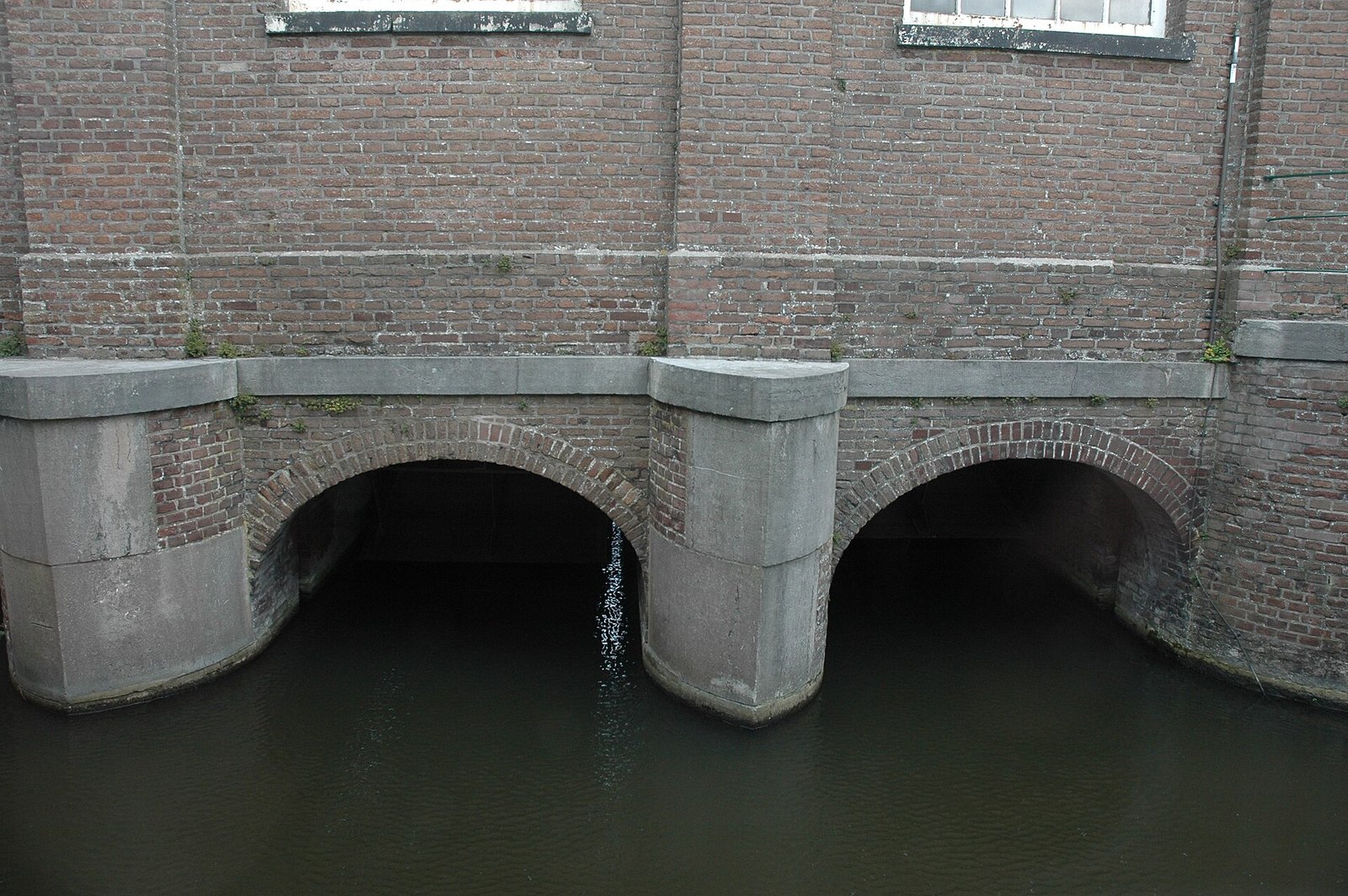
Halfway there was a lock between the Haarlemmermeer lake and the IJ. There you had to change to another barge, and a village grew up around that transfer point. It still bears the name: Halfweg, "halfway".
A network across Holland
The success was quickly copied. Between 1632 and 1665 more than 650 kilometres of towing canal were dug in the Dutch Republic, linking 39 towns. In 1657 the line was extended from Haarlem to Leiden, and on that stretch alone more than thirteen million people travelled between 1657 and 1860. A fixed, published timetable with fixed fares was unusual at the time. It was not the first in the world: Brussels had a barge service as early as 1618. But in Holland it started here.
The train alongside
The end came here first too. In 1839 the first train in the Netherlands ran alongside the canal, from Amsterdam to Haarlem. Passengers switched to the railway and the barge became redundant. Elsewhere barges ran until around 1850, on Haarlem-Leiden even until 1860. The standard work on the towing barges, by historian Jan de Vries, accordingly runs from exactly 1632 to 1839.
Nobody sails it any more. The Haarlemmertrekvaart is still there, but now serves water management. The towpath became the Haarlemmerweg. And at Halfweg, on the site of the old lock, stands a steam pumping station from 1852, now a museum that is still fired up a few times a year.
More about getting around? Read about the free ferries across the IJ.
- 01The first towing barge between Amsterdam and Haarlem ran in 1632 and had room for thirty passengers.
- 02At its peak a barge left every hour from five in the morning until eight in the evening.
- 03Halfweg means halfway: that is where you had to change to another barge.
- 04The Haarlemmerweg is the old towpath, where the horse pulling the barge walked.
- 05In 1839 the first train in the Netherlands ran alongside the canal, and that was the end of the barge.
Sources (8)
- Britannica: Trekvaart
- Erfgoedhuis Zuid-Holland: schoolplaat trekvaarten
- Wikipedia (Engels): Haarlemmertrekvaart
- Wikipedia (Engels): Trekschuit
- VLIZ: trekvaarten in de Nederlanden (pdf)
- Jan de Vries, Barges and Capitalism: Passenger Transportation in the Dutch Economy, 1632-1839 (1978)
- Hollandroute: Stoomgemaal Halfweg
- De Bosatlas van Amsterdam, Noordhoff (2015) (boekentip)