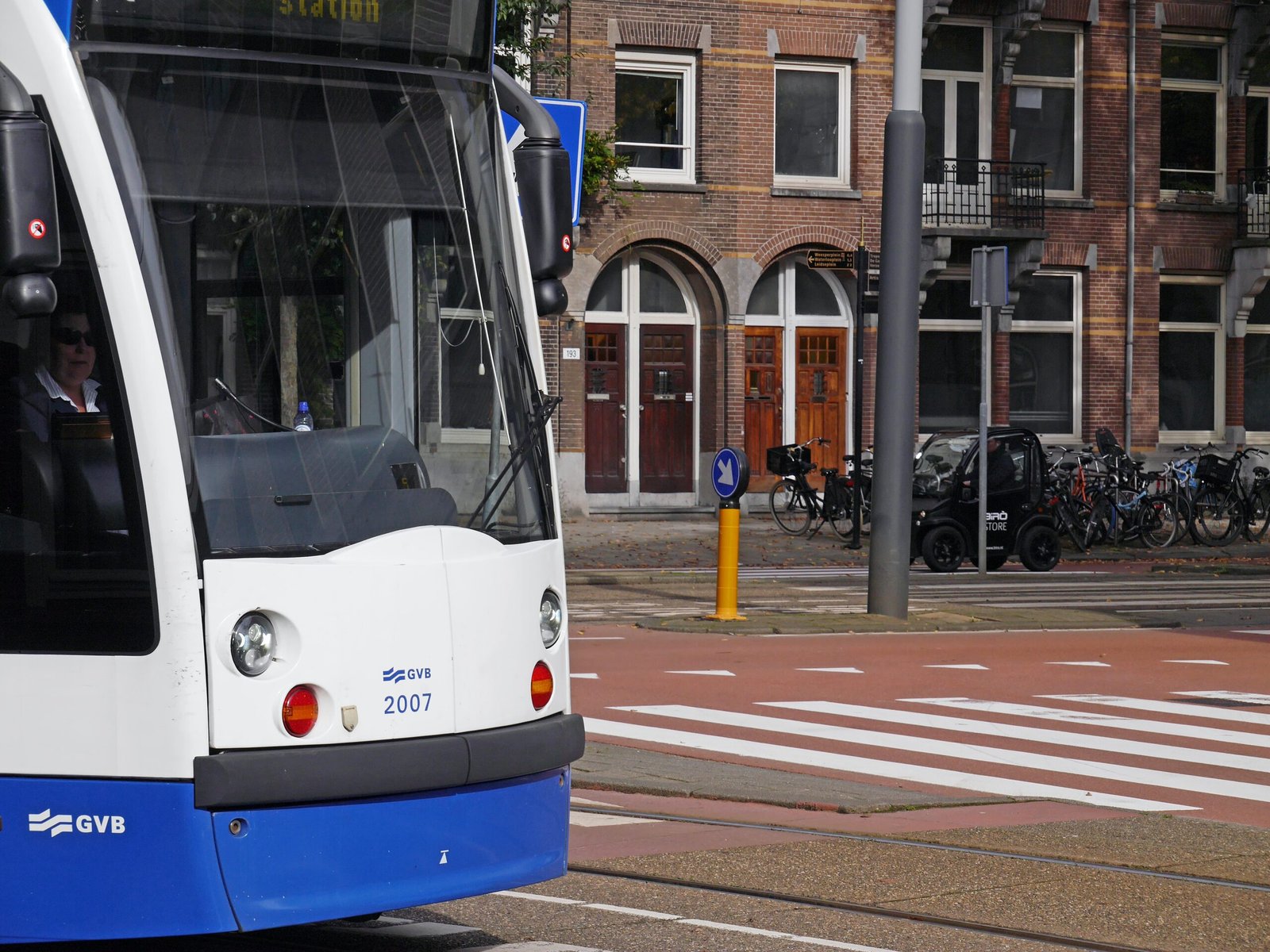
Busy times on Leidseplein
Leidseplein is without doubt the tram hub of the city. No fewer than 1,259 trams pass through here every 24 hours! Line 1 comes by the most, 150 times, and lines 2, 5, 7 and 10 also run across the square. The stops have been moved in recent years, though, to relieve the pressure on the square.
All the numbers
- There are 650 points, almost all of which are operated automatically (keep an eye out for the 'traffic lights' with the blue lines. They show you which way the points are set);
- There are 200 kilometres of track in the city. Not all of it is still in use, mind you. A loop on the Stadionweg, for instance, vanished from the timetable a few years ago when a tram derailed there;
- There are 213 trams running through the city. This number will change with the arrival of a new type of tram, and with it the disappearance of the 11G and 12G types;
- The busiest line in the city is line 5, with 42,000 passengers a day;
- Amsterdam has 500 stops;
- The predecessor of today's GVB (the municipal transport company) started in 1871 with a first line between the Plantage and the Dam via Muiderstraat, Blauwbrug and Rembrandtplein;
- The shortest line in the city is line 4, at 6.1 kilometres;
- The longest line is 19, with a length of 15.4 kilometres;
- A tram weighs on average 36 tonnes! That is 9 elephants;
- The top speed the trams can reach is 70 kilometres an hour. Although you rarely hit that speed because of the many stops. When the trams head back to the depot after their shift, though, you do sometimes see them going faster.
- The type of tram you see most in Amsterdam is the Combino by Siemens. These were built by Siemens between 2002 and 2004. There are 150 of these trams in service.
