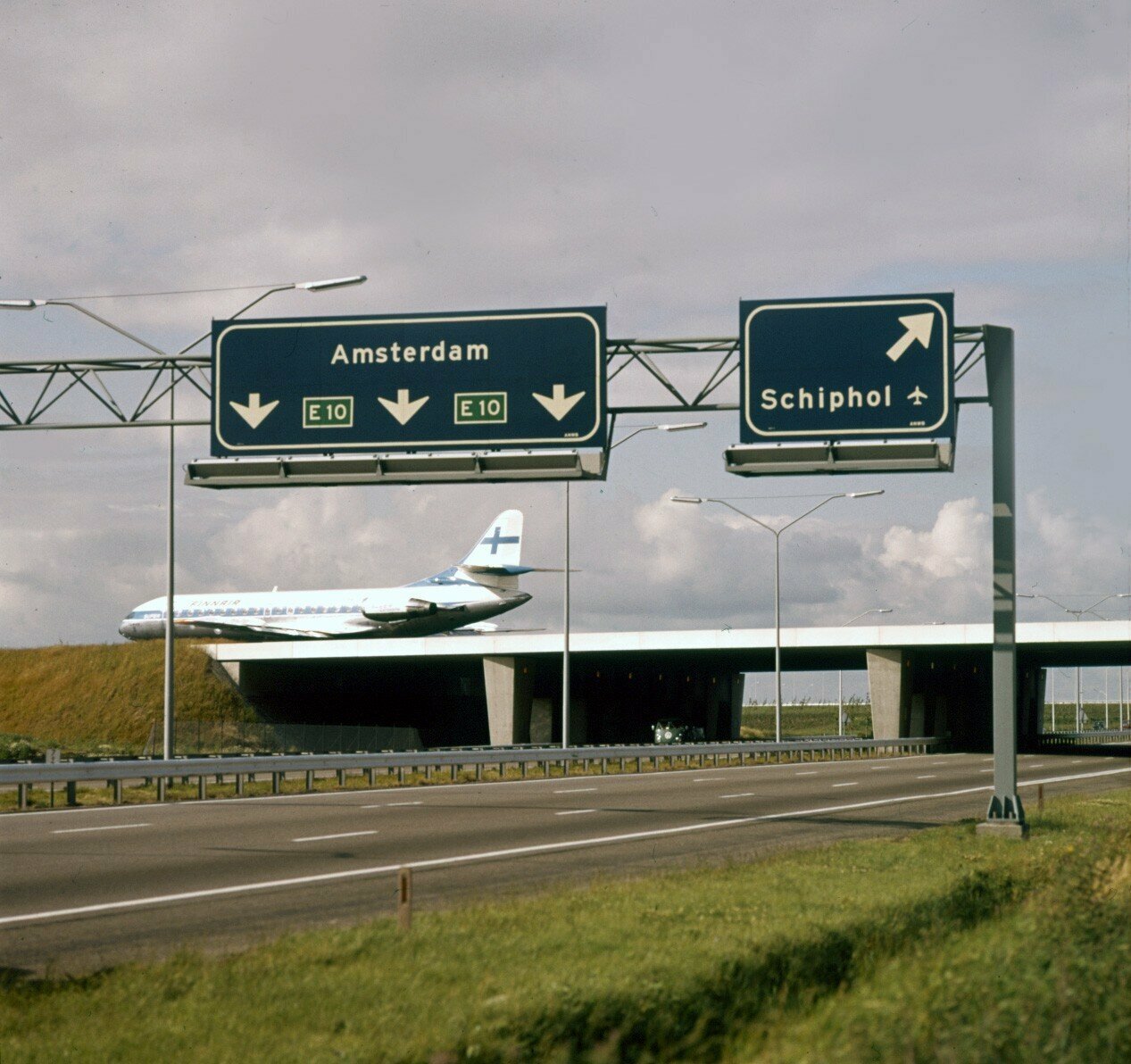
1. The term Schiphol was already in use around 1450
There are various stories about where exactly the word Schiphol comes from. The exciting version has to be consigned to the realm of fables: Ships Hell or Scheepshol was supposedly a place where many ships sank to the bottom of the lake. The most likely version of its origin comes from linguists: they argue that it must be a combination of two Gothic words: 'Skip' (wood) and 'Holl' (low-lying land). So really a place where you could fetch wood, which must have been located roughly in the north of Aalsmeer, below the town we now know as Amstelveen.
2. Schiphol was completely destroyed in the Second World War
Right at the start of the Second World War, Schiphol airfield, very strategically located for the occupier, fell into German hands. The Germans used it for its original function as a military airbase. For the Americans and the British this became an enormous threat, and so in December 1943 some 1,600 bombs fell on the site and Schiphol was completely destroyed. After the war there was briefly some question of whether the bombed airport would be rebuilt, or whether a new airfield would be built at Burgerveen, 11 kilometres away. The city of Amsterdam preferred the existing location and after the liberation in May 1945 rebuilding began in earnest. And that very same year the first passenger aircraft landed on familiar ground once more.
3. Schiphol has had its own railway station for more than forty years
Schiphol was connected to the railway network in 1978. A new line opened between the airport and the nearby Amsterdam-Zuid station. Construction of a railway tunnel under the airport, which made this new line possible, began in 1973. This tunnel lies beneath the terminal and also runs under the Buitenveldertbaan runway. Since 2001 the capacity has literally doubled and Schiphol has two railway tunnels. Schiphol is now connected by rail to countless places all over the country, but trains to Paris and Brussels also call at Schiphol.
4. The Polderbaan is Schiphol's youngest runway
You can hardly imagine it now, but it is less than twenty years since a new runway was added to Schiphol: the Polderbaan. This runway lies to the south-west of Schiphol near Vijfhuizen. If your aircraft uses this runway, by the way, you will be on the move for a while. Taxi times run up to a quarter of an hour, mainly because the Zwanenburgbaan runway 'is in the way'. Crossing it would be too dangerous, so a special route to and from the Polderbaan was built later.
