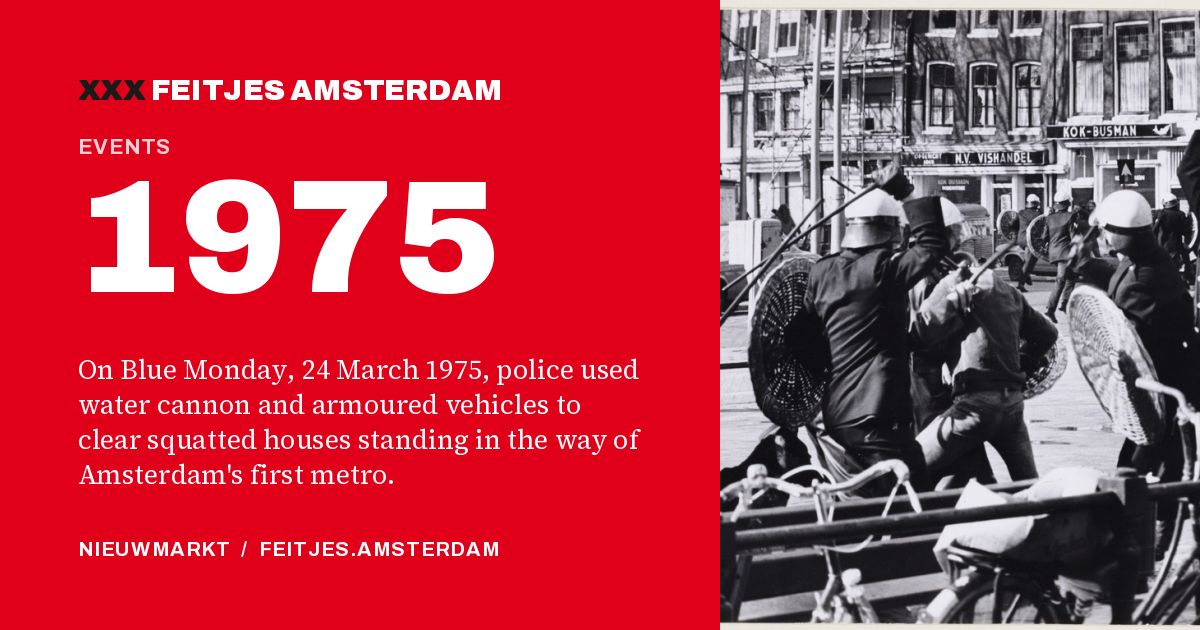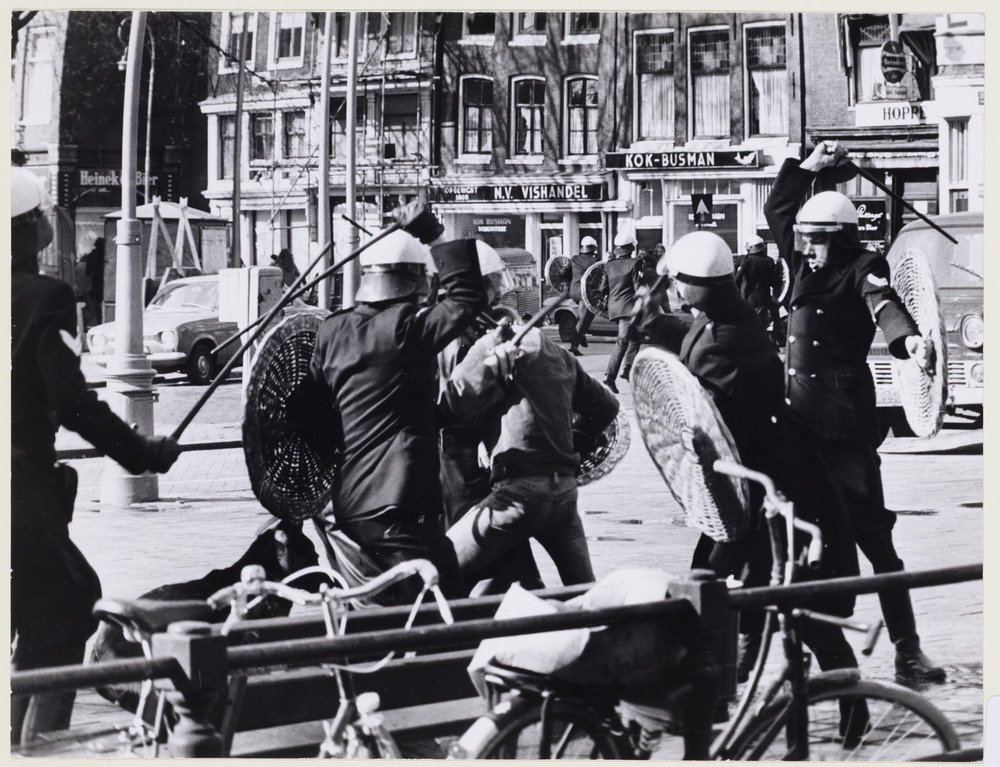
Stroll across the Nieuwmarkt today and you see canal houses, café terraces and De Waag. Little suggests that in the spring of 1975 this neighbourhood saw Amsterdam's fiercest street battles in decades. The cause: the city's first metro line, cut straight through one of its oldest districts.
A neighbourhood marked for demolition
In 1968 the city council approved a plan for four metro lines. The East Line would run beneath the Nieuwmarkt to Centraal Station. Because the tunnel was built above ground in large concrete sections and then sunk into place, entire blocks of houses had to go. The city saw an opportunity too: the cleared land was earmarked for offices, car parks and a wide four-lane road. It was called modern urban renewal.
The neighbourhood disagreed. Residents argued that many buildings were still in good shape. As older inhabitants moved out, squatters, artists, students and activists moved into the empty houses. Organised as the Aktiegroep Nieuwmarkt, they occupied one home after another to slow the demolition. An alternative route the campaigners proposed was dismissed by the city.
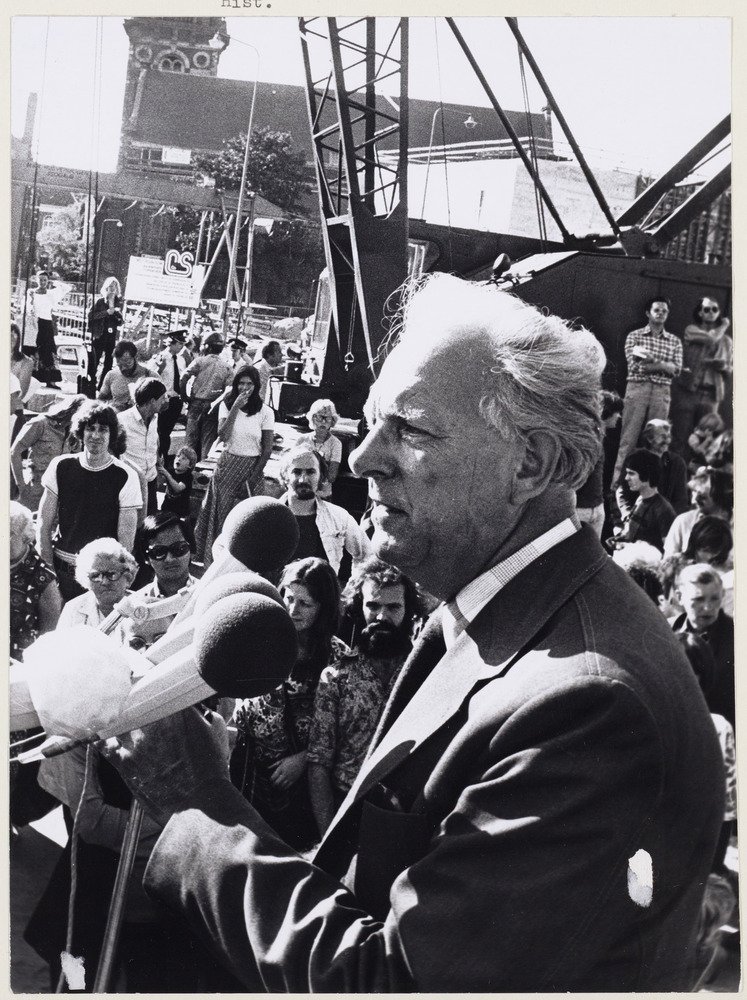
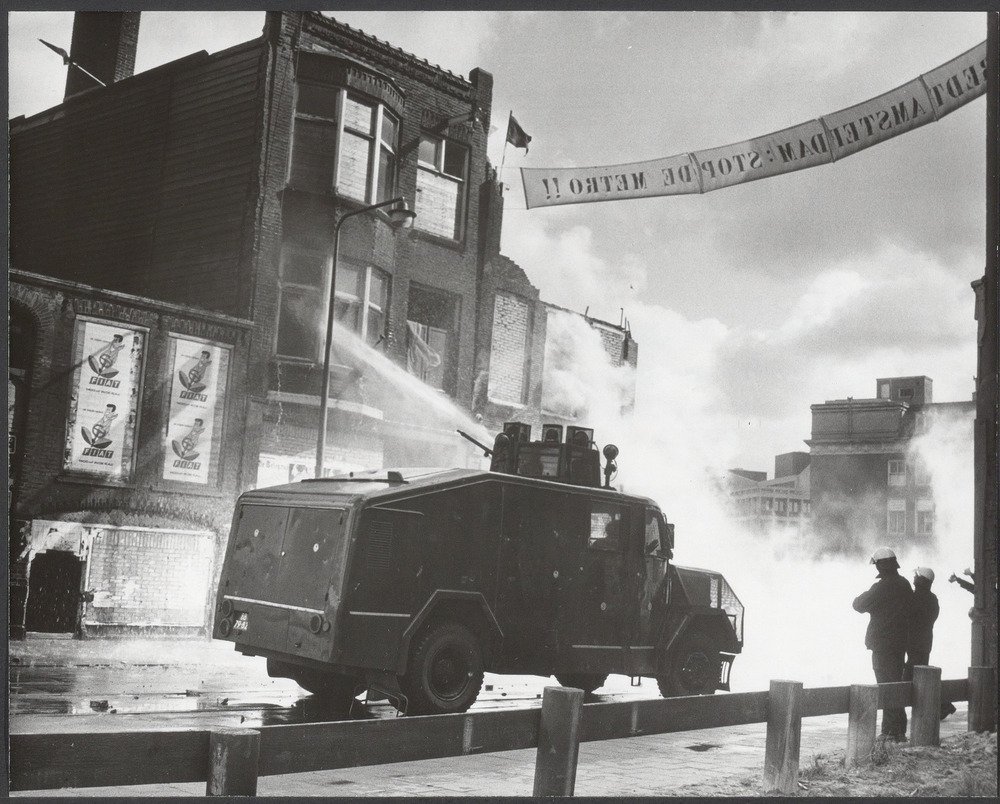
On Monday 24 March 1975 the showdown came. Police arrived with water cannon, armoured vehicles and tear gas to clear the last squatted buildings. Hundreds of protesters built barricades and pelted officers with paving stones torn from the street. While the fighting raged, the bulldozers and demolition crews carried on. The day became known as Blue Monday, and further evictions and clashes followed in the weeks after, including in Sint Antoniesbreestraat.
A battle lost, a war won
The metro was built regardless. On 11 October 1980 the first trains ran through the tunnel beneath the Nieuwmarkt to Centraal Station. Above ground, however, the story was different. The four-lane road and the office district were scrapped, fewer buildings were demolished than planned, and the neighbourhood was rebuilt largely on its old street pattern, with more social housing than originally intended. Plans for new metro lines were shelved for years. The word metro stayed sensitive for years: when the line to Amstelveen opened in 1990, the GVB preferred to call it a light-rail tram.
Architects Aldo van Eyck and Theo Bosch, who had won a competition for the area back in 1969, played a key role. Their housing block, Het Pentagon, at the head of Sint Antoniesbreestraat, follows the historic building lines, has a courtyard with passages to the surrounding streets, and homes that open directly onto the street. Not wholesale clearance, but small-scale building meant to bring back the old liveliness.
That shift was part of a wider movement. Under alderman Jan Schaefer, 'building for the neighbourhood' (bouwen voor de buurt) became the motto of Amsterdam's urban renewal: affordable rented homes for the people who already lived there, keeping the street pattern and the mix of housing, work and cafés. The Nieuwmarkt proved that residents could help shape their city.
At Nieuwmarkt station the struggle is still visible. Artworks recall the riots, a wrecking ball symbolically smashes through a wall, and the floor carries the words 'Wonen is geen gunst maar een recht': housing is not a favour but a right.
- 01The riots of 24 March 1975 are known as Blue Monday.
- 02The metro tunnel was built above ground and then sunk, which is why whole blocks had to go.
- 03The four-lane road planned through the neighbourhood was never built.
- 04Only on 11 October 1980 did the metro run beneath the Nieuwmarkt to Centraal Station.
- 05The floor of Nieuwmarkt station reads: 'Wonen is geen gunst maar een recht' (housing is not a favour but a right).