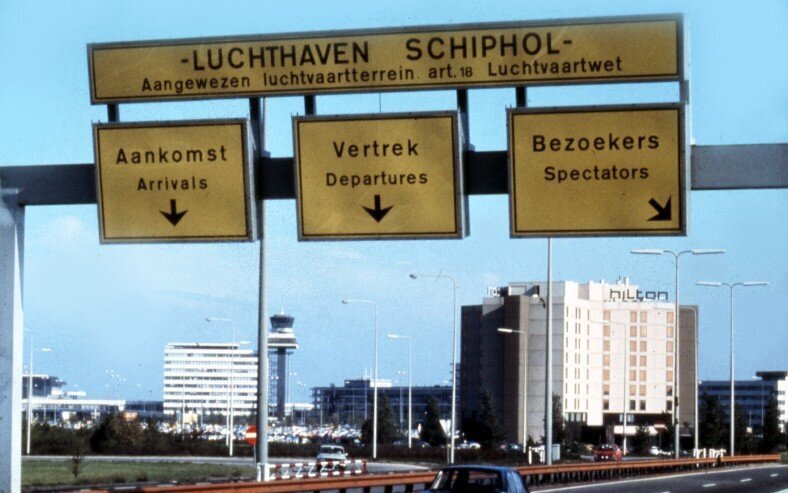
Military airfield
In 1916 Schiphol became a military air base, a new strategic role that responded to the rise of aviation technology. It really was still an airfield at the time, almost entirely grass. The air base developed quickly, and after the First World War civil aviation increasingly took off. In 1919 the Koninklijke Luchtvaart Maatschappij (KLM) was founded in The Hague, choosing Schiphol as its home base. This was a crucial moment in the development of the airfield, which thereby began to outgrow its military role.
The Games bring growth
In 1926 the city council of Amsterdam took over the management of Schiphol. This takeover stemmed from the wish to make the airfield fit for the Olympic Games of 1928. Major improvements were made to the air base, including better runways and facilities for travellers. These changes made Schiphol an attractive location for both domestic and international flights.

During the Second World War, Schiphol suffered heavy damage from German bombing. The airfield was almost completely destroyed, but reconstruction began immediately after the war. In the decades that followed, Schiphol grew into one of the most important airports in Europe, partly thanks to a strategic focus on innovation and scaling up.
Growth from the 1960s onwards
The 1960s marked the beginning of Schiphol as a modern airport. The design centred on a single-terminal concept, with arrival and departure halls, a railway station and commercial facilities all within walking distance. In addition, five runways were built, considerably increasing the airport's capacity. In 2003 the airport was further expanded with the opening of what is for now the latest new runway: the Polderbaan. One of the longest in Europe.

70 million passengers
Today Amsterdam Airport Schiphol is one of the busiest and most efficient airports in the world. It is a crucial hub for intercontinental flights and plays a key role in the Dutch economy. Thanks to the 'one-terminal' concept, Schiphol offers travellers a fast and user-friendly experience. It is no coincidence that well over 70 million passengers pass through Schiphol every year.

- 01Schiphol handles more than 70 million passengers and 1.5 million tonnes of cargo every year.
- 02The airport has six runways, of which the Polderbaan is the longest at 3.8 kilometres.
- 03Schiphol covers an area of 27 square kilometres, making it one of the largest airports in the world.
- 04You can read more facts about Schiphol here.
