A girl from the Lindengracht
Hendrika Elisabeth Jansen was born in Amsterdam on 8 October 1924, the daughter of a fishmonger with a stall on the Lindengracht. She grew up between the Lindengracht and the Herenmarkt, in the heart of the Jordaan. She wanted to sing from an early age, but the road to the stage was far from straight. In 1947 she performed in Haarlem as the supposedly Portuguese singer Rosita Lavièro. The alias did not last: audiences simply recognised the girl from Amsterdam.
Zwarte Riek is born
The real breakthrough came in the mid-1950s, when she was already in her early thirties. Her partner and manager Kees Manders launched her as Zwarte Riek, after her raven-black hair. In 1956 came 'M'n wiegie was een stijfselkissie' (My cradle was a starch box), a cheerful Jordaan song that Manders is said to have originally written for Johnny Jordaan. It was her big breakthrough, and the same year brought 'Alle apies (in de Artis lijken op me ome Hein)' (All the monkeys at the zoo look like my uncle Hein). She became so popular that she was driven through the neighbourhood as the 'princess of the Jordaan' in a carriage pulled by four horses.
Remarkably, her broad Amsterdam accent was not always an advantage. In the theatre world it held her back, and she even took elocution lessons to lose it. In the levenslied, the Dutch tearjerker ballad, it was her trademark.
From the Thorbeckeplein to Carré
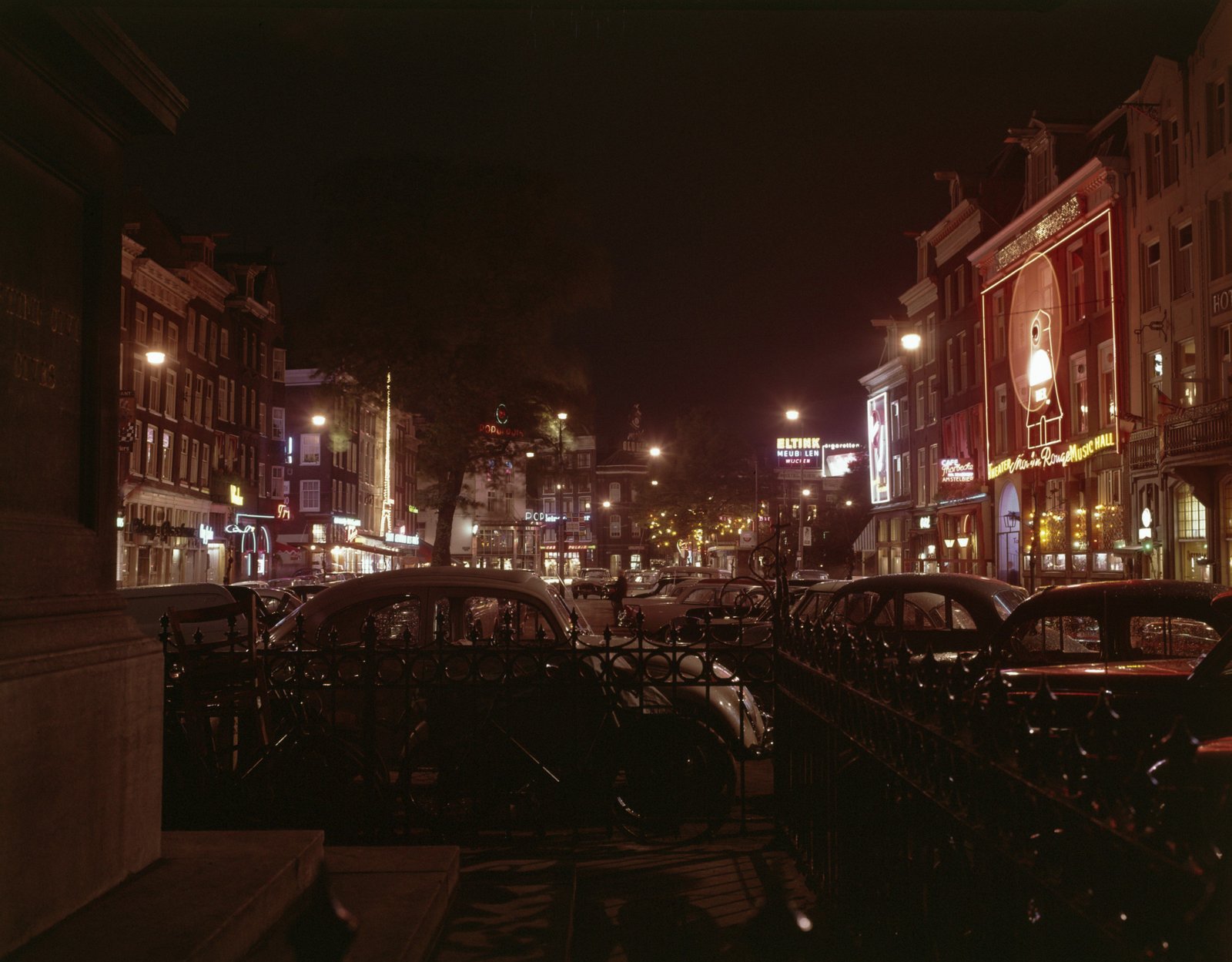
In 1958 Manders bought café Het Uiltje at Thorbeckeplein 5, just around the corner from the Rembrandtplein, and in June 1960 turned it into nightclub Moulin Rouge. There Zwarte Riek took the stage night after night. But she wanted more. In 1962 she played the show 'Tussen plumes, pluche en plastic' (Between plumes, plush and plastic) for three months at the Rembrandttheater, and on 28 March 1963 she played her own show to a sold-out Carré. Feathers, glitter, a big orchestra: Zwarte Riek with international flair. She performed in Cannes, Israel, Aruba and Curaçao, and even at Carnegie Hall in New York.
Yet the glamour did not last. After 1964 she let go of the big productions and glittering costumes and went back to simple Dutch-language songs, where she felt most at home.
I have simply always been sentimental.
Rika Jansen, in Ons Amsterdam
Amsterdam cries
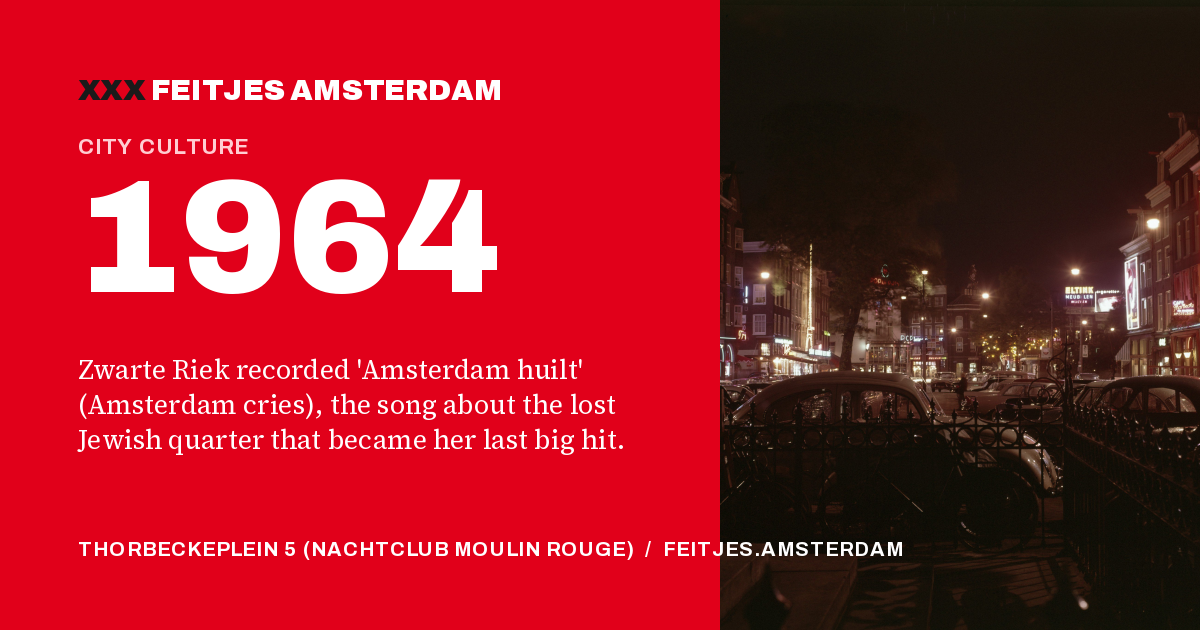
The song that secured her place in Amsterdam's memory came out in 1964. Manders wrote 'Amsterdam huilt (waar het eens heeft gelachen)' (Amsterdam cries, where it once laughed) at her own request. It is about the old Jewish quarter around the Weesperstraat and the Waterlooplein, which buzzed with trade and life before the war and was left empty and silent after the deportations. It became her last big hit in the Netherlands, and the song moved her every time she sang it. She had a simple explanation for that: she had always been sentimental.
"There are no Amsterdammers left"
In 1968 the nightclubs were sold and Rika moved to Zandvoort, where she lived for the rest of her life. She was not kind about her city in later years: "there are no Amsterdammers living there any more", she told De Telegraaf in 2006. She died in Zandvoort on 21 January 2016, aged 91. Amsterdam never gave her a street or a statue, but since 2010 a tile with her photo has been part of the Walk of Fame in Zandvoort.
More Amsterdam music? Read how Tulips from Amsterdam did not come from Amsterdam at all, or about the foreign originals behind Hazes' hits.

- 01As a girl, Rika Jansen fell into the Geldersekade and caught typhoid and Weil's disease.
- 02In 1957 she recorded with her sister Marie as The Lelystreet Sisters.
- 03'M'n wiegie was een stijfselkissie' is said to have been written for Johnny Jordaan originally.
- 04She owed her stage name Zwarte Riek (Black Riek) to her raven-black hair.
- 05She performed at Carnegie Hall in New York, a long way from her father's fish stall on the Lindengracht.
Sources (5)
- Jan Vriend, 'Amsterdam in 750 feiten, quotes, gebeurtenissen en anekdotes', Edicola, 2024
- Henk van Gelder, 'Jansen, Hendrika Elisabeth (1924-2016)', Digitaal Vrouwenlexicon van Nederland, Huygens ING, 2016
- Marcella van der Weg, 'Rika Jansen: zangeres van het Amsterdamse levenslied', Ons Amsterdam, 2015
- Amsterdam 750, 'Ode aan Hendrika Elisabeth Jansen, Zwarte Riek', amsterdam750.nl, 2025
- NH Nieuws, 'Zangeres Zwarte Riek (91) overleden', 2016