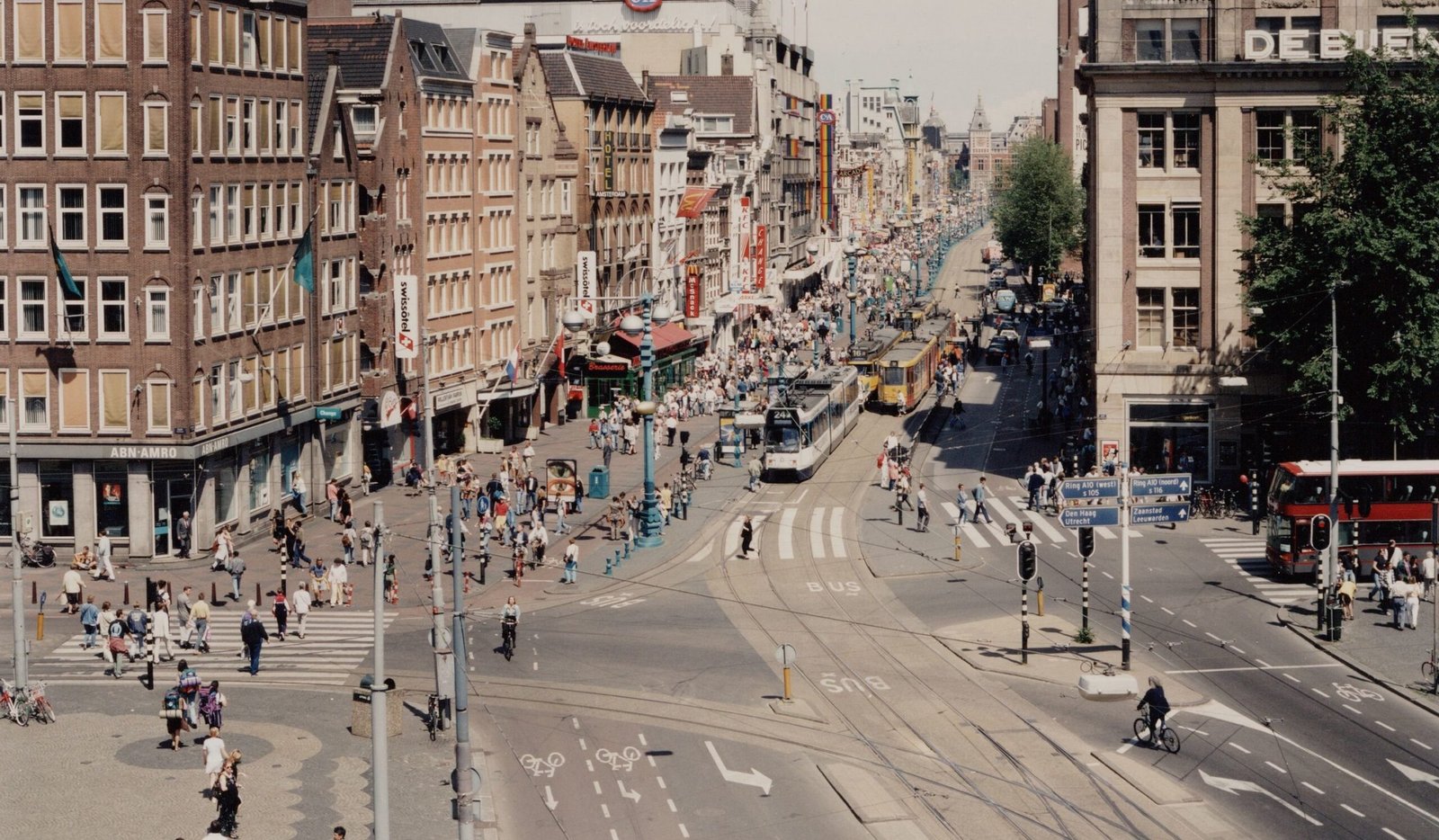
Roundabout and taxi rank
Driving your car across the Dam is still possible today in the direction of Centraal Station and partly in the direction of the Nieuwmarkt. That, however, is a trifle compared with the heavy car traffic that once used the square. In recent years the car has been driven off the Dam more and more through redesigns and traffic measures. The most recent change dates from 2018, when the Paleisstraat was made car-free.
Around the turn of the century, though, far more car traffic was still possible on the square. There was a roundabout around the Nationaal Monument, for instance, so you could pull up in front of the entrance to the Bijenkorf, and there was a taxi rank beneath the steps of the Royal Palace on the Dam. On top of that, cars could drive along both sides of the Palace. In the middle of the Dam there was even a big traffic sign of the kind you usually find at large roundabouts and junctions.
New ideas about cars
The 1970s ideal of the car had largely faded by the turn of the millennium. Above all, Amsterdammers wanted fewer cars on important (tourist) squares. Once the redesign of that other big square, the Museumplein, had been completed, a major overhaul of the Dam's layout began in 2000.
From asphalt to Dam cobbles
Although they look tremendously authentic and historic, the Dam cobbles have only adorned the square for twenty years. Until 1999 there was asphalt in front of the entrances to the Bijenkorf and Krasnapolsky, forming a roundabout around the Nationaal Monument. So the monument really was a little 'island' on the square, which you could only reach by crossing the road.
- 01Naturally, tunnelling also took place beneath the Dam for the construction of the Noord/Zuidlijn (the North/South metro line). The tunnel boring machines passed under the square in 2010.
