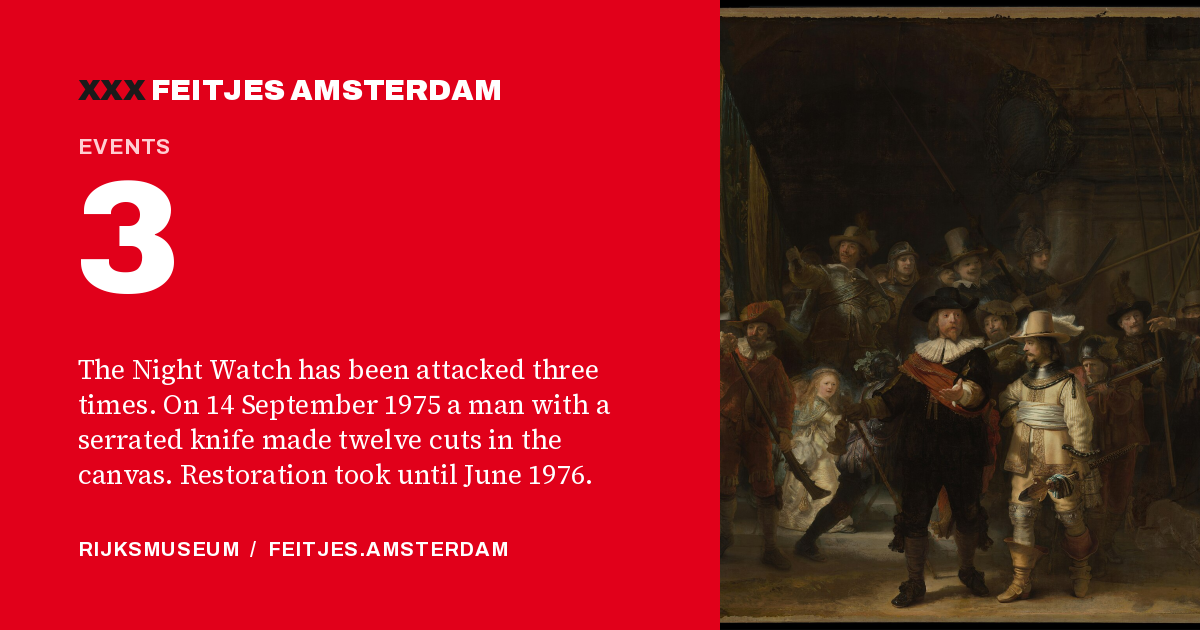
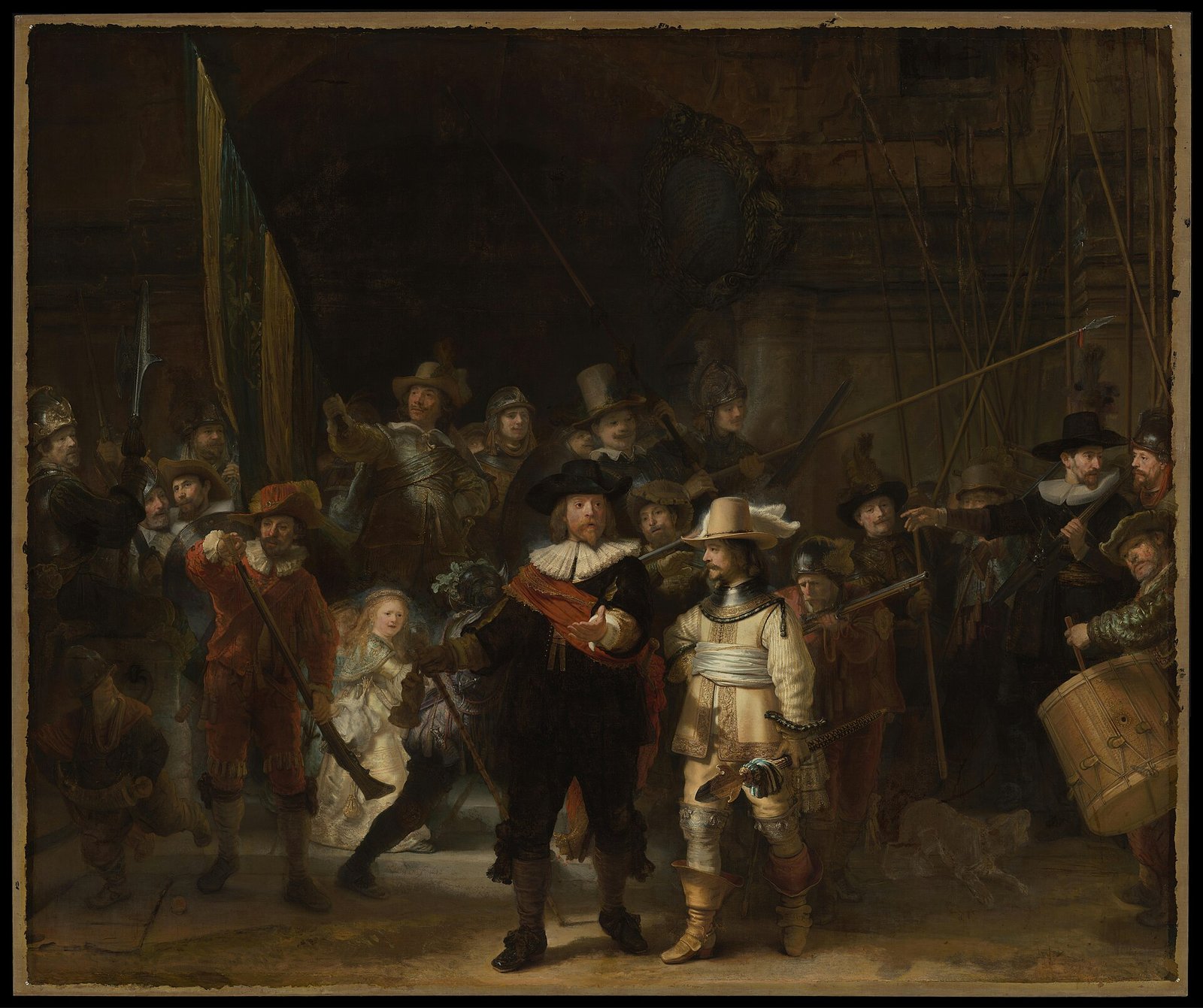
Every day hundreds of people stand in front of The Night Watch in the Gallery of Honour at the Rijksmuseum. Few of them know that the most famous painting in the Netherlands has been attacked three times: with a knife, with a bread knife and with acid. Twice a museum guard prevented worse.
1911: a knife against the varnish
On 13 January 1911 an unemployed man, a former ship's cook, went for the painting with a shoemaker's knife. He wanted to protest against the fact that he could not find work. The blade did not get through the thick layer of varnish that covered the canvas at the time. Only the varnish was damaged and the painting itself was unharmed.
1975: twelve cuts on a Sunday afternoon
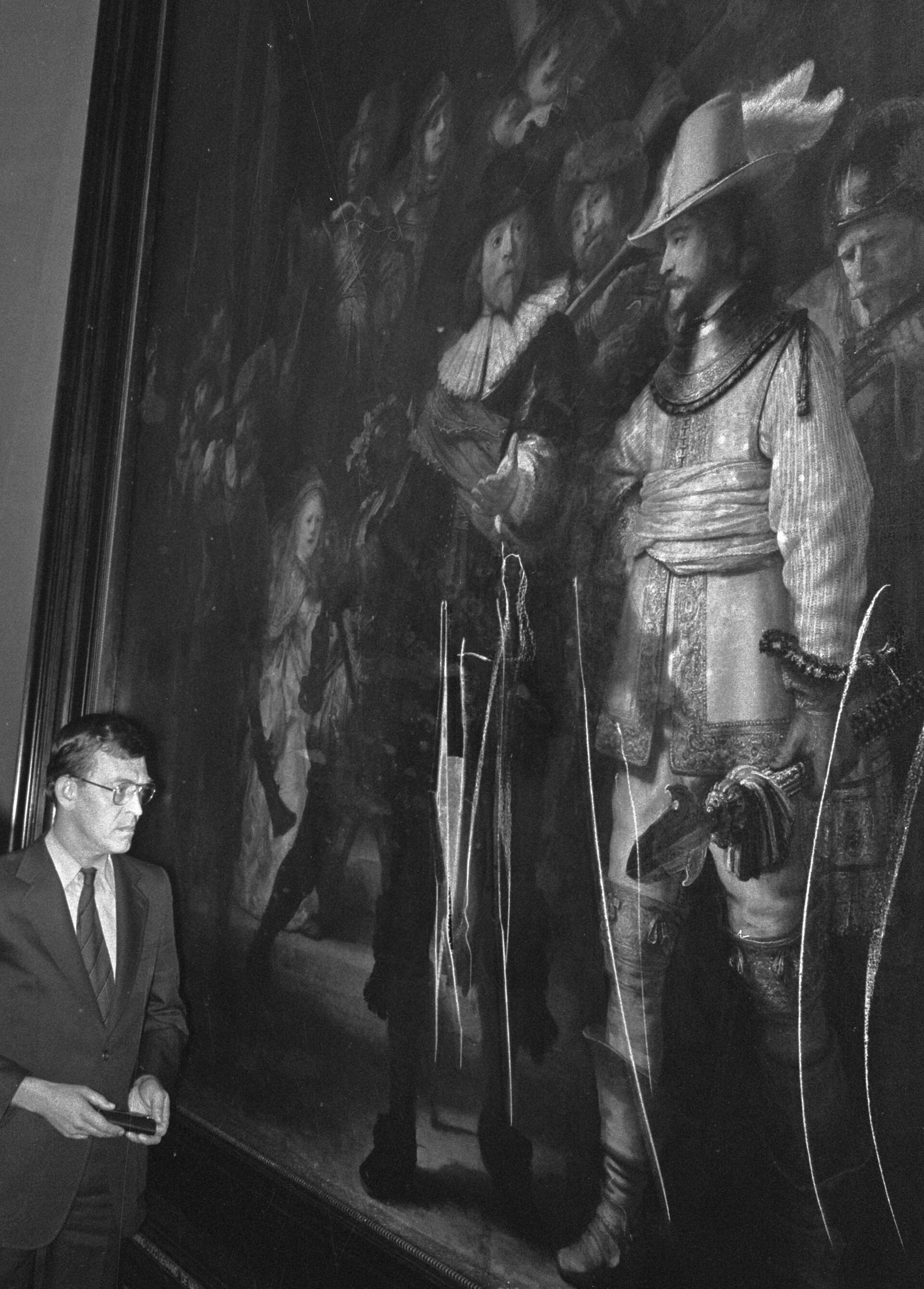
The worst attack came on Sunday 14 September 1975. The museum opened at 1pm as usual. A tall man stepped onto the carpet in front of the painting and was asked to move back. He returned with a serrated table knife and slashed the canvas. Museum guard W. Stroman grabbed his arm and called for help, and a young visitor, P. Chr. van den Berg, helped pull the man away. Both later received the museum's silver medal.
The damage was serious. There were twelve cuts and scratches, some right through the canvas. Near the breeches of Captain Frans Banninck Cocq, a triangular piece of about 28 by 6 centimetres was cut out and fell to the floor. The attacker, an unemployed teacher with mental health problems, never stood trial.
A restoration in full view
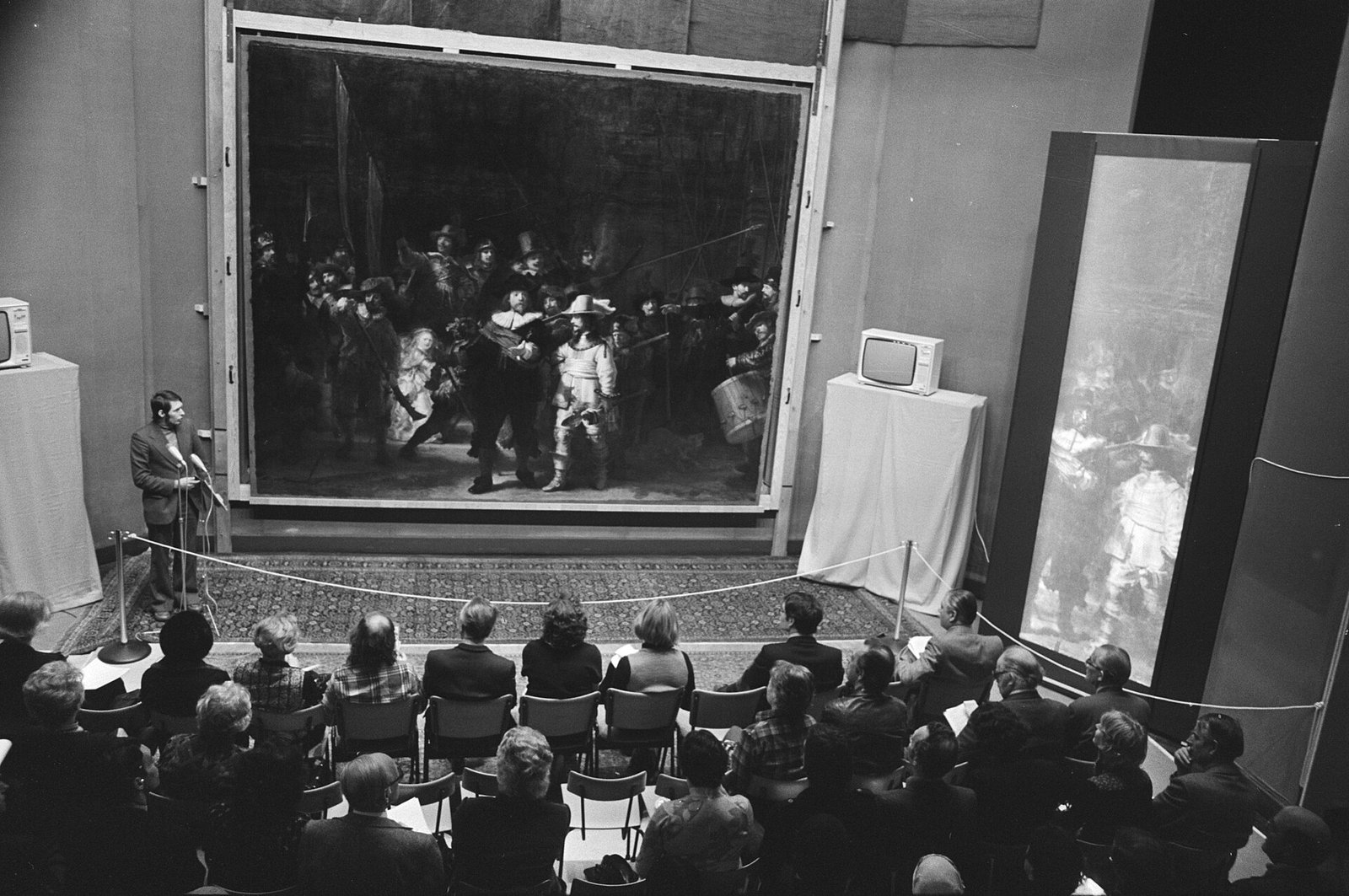
The next day the cuts were taped on the front and back, and the loose piece was put back in place. The museum built a temporary studio inside the gallery, with air conditioning and windows so visitors could watch. Chief restorer Luitsen Kuiper and his team started work on 30 September 1975.
They repaired the cuts with linen fibres and an epoxy adhesive, attached a new lining canvas to the back and removed the old varnish and earlier retouching. The new varnish then needed months to harden. On 3 June 1976 The Night Watch was officially back in place, in a new frame. Up close, some traces can still be seen today.
There is a twist: the museum had wanted to replace the varnish since 1972, because it had become brittle and yellow. As a result the restorers were better prepared than they would otherwise have been.
1990: acid from a spray bottle
In April 1990 a man sprayed acid onto the painting from a hidden pump bottle. He was a psychiatric patient who had run away. An alert guard intervened and immediately rinsed the canvas with water. The acid only reached the varnish, just like the knife in 1911, and that damage was repaired too.
Also read: Violence in the streets during the worst riots in peacetime. It's 30 April 1980, a Queen's Day with a special twist. Today Juliana is stepping down from the throne to make way for...
Operation Night Watch
Since July 2019 the painting has stood in a glass enclosure in the gallery, where researchers and conservators study it in full view of the public. On 12 November 2024 a team of eight conservators began removing the varnish applied in 1975 and 1976. As they work, the damage from the knife and acid attacks is coming to light again. Nobody knows exactly how long it will take. Director Taco Dibbits says the painting itself sets the pace.
In all, the museum has treated The Night Watch around 25 times. The best known is still the one after 1975: news of the attack went out on radio and television that same afternoon, and across Europe via Eurovision.
Keep reading
- 01The Night Watch has been attacked three times: in 1911, 1975 and 1990.
- 02In 1975 a man cut the canvas twelve times, and a triangle of 28 by 6 centimetres fell to the floor.
- 03The 1975 restoration took place inside the gallery, with windows for visitors to watch.
- 04On 3 June 1976 the painting was officially back on display.
- 05In 1990 a guard rinsed the acid off at once, so only the varnish was damaged.
Sources (11)
- Rijksmuseum Bulletin: P.J.J. van Thiel, Beschadiging en herstel van Rembrandts Nachtwacht (1976)
- Rijksmuseum Bulletin: L. Kuiper en W. Hesterman, restauratieverslag van de Nachtwacht
- Rijksmuseum Bulletin: verslag van de presentatie van de gerestaureerde Nachtwacht
- Rijksmuseum: 10 dingen over Rembrandts Nachtwacht
- Rijksmuseum: Bros vernis (Operatie Nachtwacht)
- Rijksmuseum: How The Night Watch survived a knife attack
- Wikipedia: The Night Watch
- VRT NWS: Waarom is De Nachtwacht zo bijzonder? (2018)
- Open Beelden: Polygoonjournaal over de restauratie (1976)
- NOS: Restauratie van De Nachtwacht begonnen (12 november 2024)
- NH Nieuws: Restauratie De Nachtwacht van start