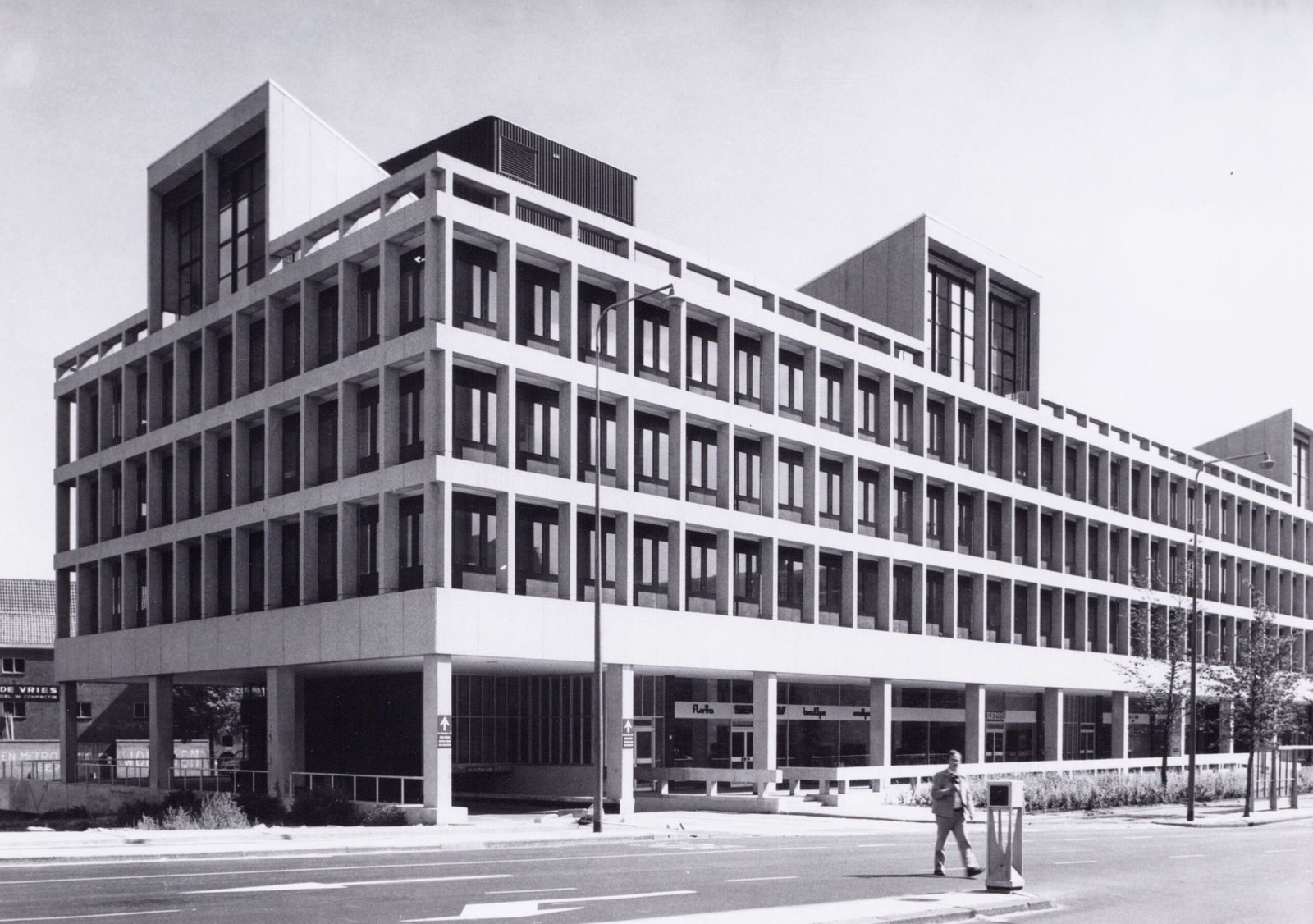
Thinking big
The Burgemeester Tellegenhuis (named after Amsterdam mayor J.W. Tellegen) opened in 1971, in the middle of a turbulent period in the city. With the Wibautstraat and the Weesperstraat, the city was busy at full speed building an urban motorway and a metro, and to make room for them historic (though dilapidated) buildings were being demolished, especially in the Nieuwmarkt neighbourhood. According to the City Formation Plan, wide roads call for large buildings, and so at the end of the sixties the Burg. Tellegenhuis was erected. Co-financed by Amsterdam businessman Maup Caransa.
Maupoleum
The building was anything but a success, neither among its users nor, certainly, among the people of Amsterdam. A planned shopping boulevard on the ground floor flopped, and the University of Amsterdam also complained about things like the poor ventilation. It really made the Tellegenhuis unsuitable as a place of education. Caransa naturally wanted his building to pay its way, which resulted in hefty rents for the tenants of what, partly for that reason, became known as the Maupoleum (a pun on Maup and mausoleum).
The end in sight
A combination of complaints about poor temperature control and high rents meant that by the mid-1980s, barely 10 years after completion, the Maupoleum was already partly empty. Part of the truly colossal building was squatted, and with that the decline had begun. The tide had turned: the people of Amsterdam had no appetite for large buildings in their city centre. The metro had arrived after serious riots, the urban motorway had not. And it is precisely at the site of this building that you can see this clearly in the course of the Weesperstraat.
Paint and the wrecking ball
In the spring of 1994 the moment came: a bag of white paint was symbolically thrown at the building to mark the start of demolition. The paint was a nod to the building's architect, who really didn't think demolition was necessary; according to him a lick of paint was enough to enjoy it for many more years. So the building got its lick of paint, but after that the wrecking ball inevitably followed.
A body in the building
Just before demolition a gruesome discovery was made in the Maupoleum. Behind a partition wall the body of a man was found, wrapped in plastic. The body turned out to have been lying there for many years. After a police investigation it became clear that the body had been hidden there four years earlier by a drug dealer, at a time when the building had become the domain of squatters. It turned out to be a German man, a junkie. The dealer was sent to prison for four years for the murder. The hidden body perhaps says a lot about the state the building was already in at the time. It really was doomed...
