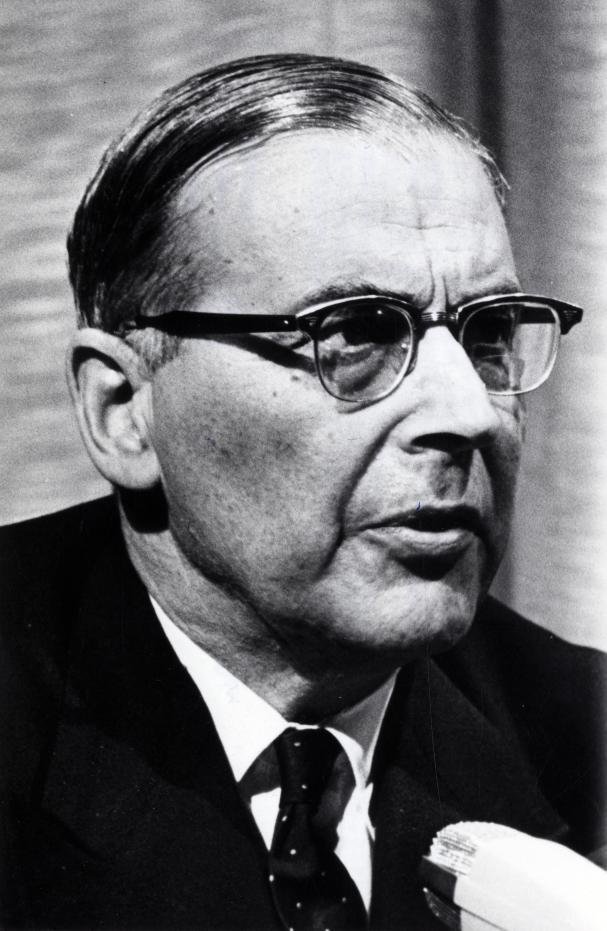
Gijs van Hall
- Mayor
- 1957-1967
- Life
- 1904-1977
- Party
- PvdA
The story
Gijs van Hall was born in Amsterdam on 21 April 1904 into a well-known banking family. He studied law in Leiden, worked for a bank in New York and went on to run the Amsterdam Trusteekantoor and later the Labouchère bank.
The resistance bankers
During the Second World War he and his brother Walraven financed much of the Dutch resistance. Walraven led the Nationaal Steunfonds, a secret fund that supported resistance groups, people in hiding, strikers and those left without income. One of their most daring tricks: the brothers forged treasury bonds and secretly swapped them for real ones in the vault of the Dutch central bank. Walraven was betrayed and executed by the Germans in February 1945.
Mayor of a restless city
On 1 February 1957 Van Hall succeeded the popular d'Ailly. He had no political experience and ran the city like a business. His start was promising: he championed the IJ and Coen tunnels and the addition of the Bijlmermeer polder to Amsterdam, where a whole new district would rise.
But the 1960s brought unrest. Provo, a playful anarchist youth movement, and other young people challenged authority, and there were protests against the Vietnam War. Van Hall was on bad terms with his police chief, Van der Molen, and left public order largely to the police.
Smoke over the Raadhuisstraat
On 10 March 1966 Crown Princess Beatrix married the German diplomat Claus von Amsberg. Van Hall would rather not have had the wedding in his city and urged Prime Minister Cals to hold it in The Hague. Cals refused. On the day itself, more than two million television viewers watched smoke bombs explode in the Raadhuisstraat as the Golden Coach rolled past. In an interview with TV presenter Mies Bouwman, a visibly shaken Van Hall admitted he did not really know how to proceed and suggested psychologists might help.
The final blow came three months later. On 13 June 1966 a protest by construction workers over holiday pay turned into fights near the offices of the De Telegraaf newspaper on the Nieuwezijds Voorburgwal. One demonstrator died. The next day thousands of construction workers marched through the city, setting cars on fire; 63 civilians and 28 police officers were injured.
Dismissed
The police chief was fired and an inquiry followed. The new De Jong cabinet decided Van Hall had to go. He refused to resign before the inquiry's report was published, so Queen Juliana dismissed him on 13 May 1967, effective 1 July. It was the first time in modern history that the government had removed a mayor of the capital. Van Hall felt unfairly treated: 'Just because I am a Van Hall, people say I have a regent's mentality,' he said, referring to the patrician elite that once ruled the city.
On leaving he received the city's gold medal of honour. He stayed in the Dutch Senate until 1971 and wrote his memoirs, Ervaringen van een Amsterdammer (Experiences of an Amsterdammer). Gijs van Hall died in Amsterdam on 22 May 1977.
- 01With his brother Walraven, Van Hall swapped forged treasury bonds for real ones in the central bank's vault.
- 02He would have preferred Beatrix and Claus to marry in The Hague.
- 03He championed the IJ tunnel and the Coen tunnel.
- 04In 1967 he became the first mayor of the capital in modern times to be dismissed by the government.
- 05His memoirs are called Ervaringen van een Amsterdammer.
Where would Mayor Van Hall have preferred Beatrix and Claus to marry in 1966?
Play the full quizStories on the site
Sources (4)
Comments
Do you know more? Do you live there, know your grandfather's story, or spot a mistake? Tell us here. That is how this register grows with what Amsterdammers know.