From coal to gas: a long history
The Centrale Hemweg was built in 1952 on behalf of the Gemeentelijk Energiebedrijf (GEB), Amsterdam's municipal energy company. The building, designed by the Dienst der Publieke Werken (the public works department), was to replace the outdated Centrale Noord. In 1953 the power station was officially opened and for years it stood prominently in the harbour area with eight 80 metre tall chimneys. In the sixties, units 5 and 6 (Hemweg II) followed, which could also run on natural gas and oil. The striking chimney from that era became, at 150 metres, the highest point in Amsterdam.
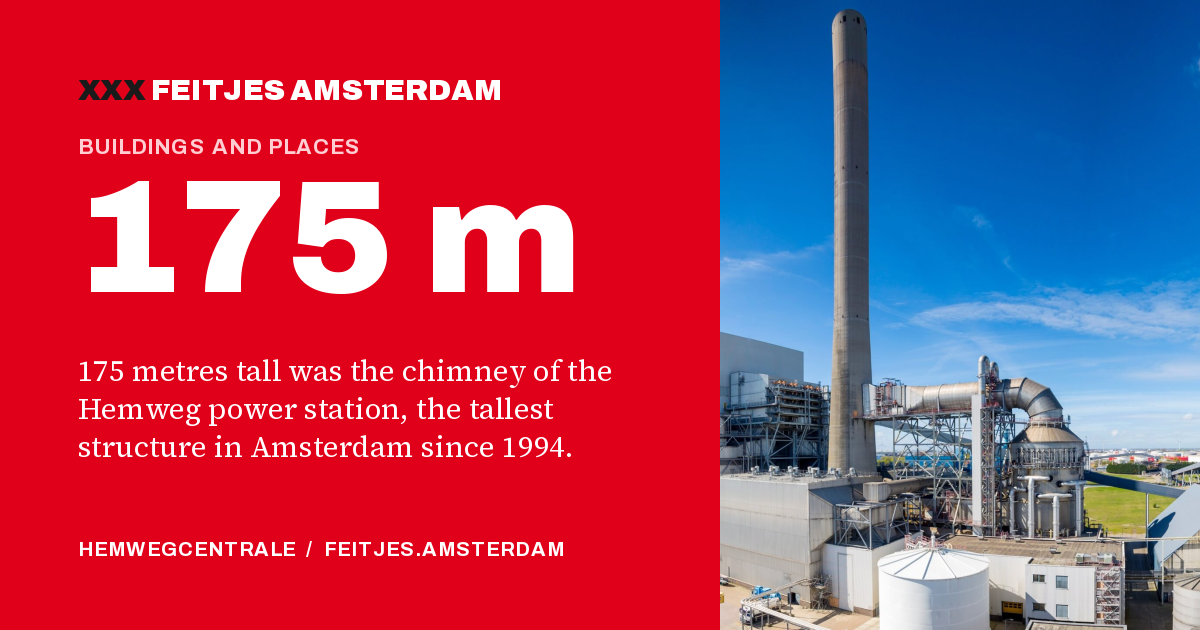
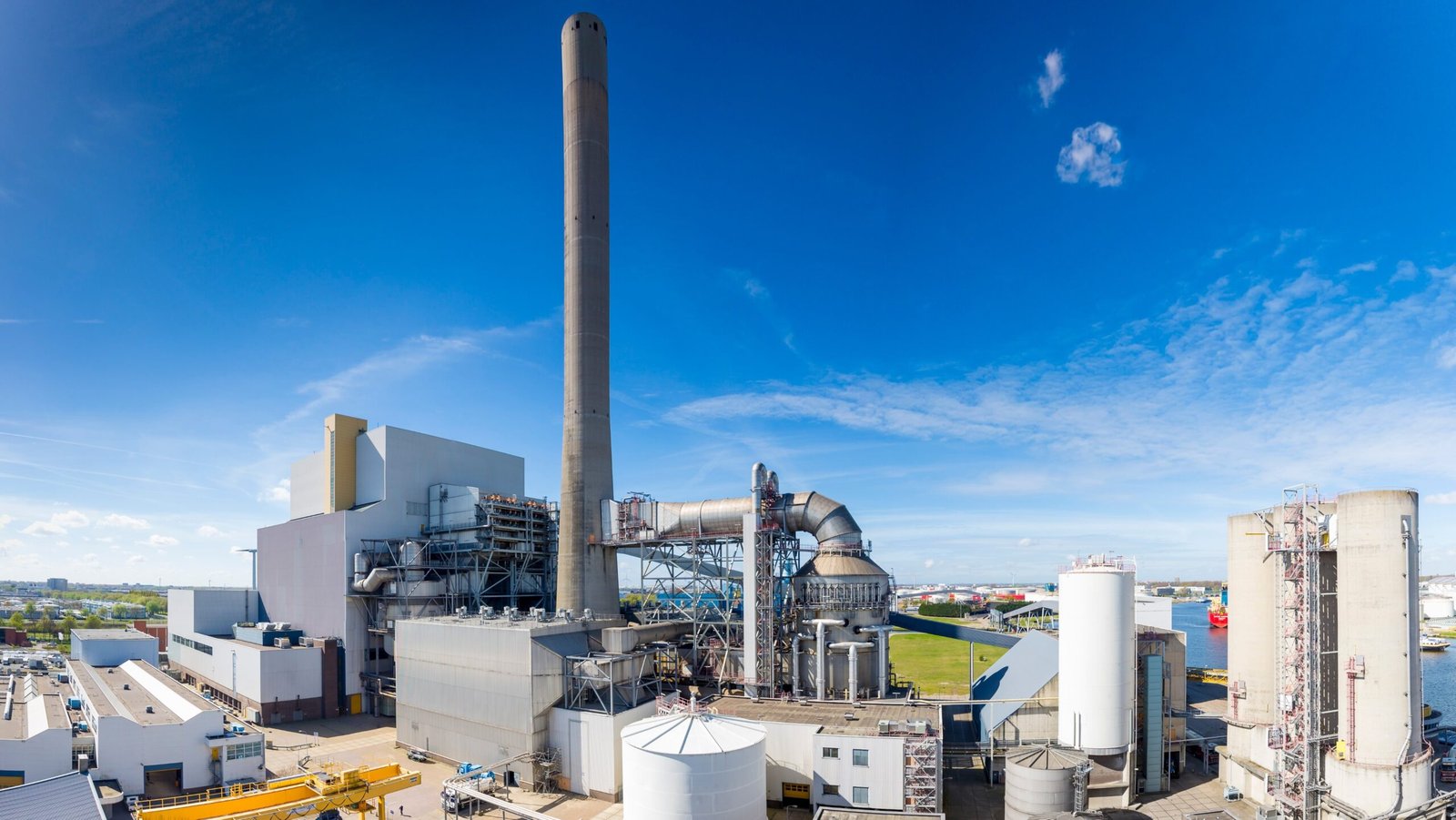
At the end of the seventies, Hemweg III was built, a gas-fired unit with an extra gas turbine. In 1994 Hemweg 8 came into service. It was a modern coal-fired plant that could burn 60 kg of pulverised coal per second and delivered 630 MW of power. The chimney rose to a height of 175 metres and quickly became a recognisable element in the Amsterdam skyline. After a period of takeovers, from UNA to Reliant Energy, then to Nuon and finally to Vattenfall, construction of Hemweg 9 started in 2010: a gas-fired plant with an efficiency of 59% and a capacity of 435 MW. Hemweg 7 was closed in 2013.
A plume of smoke as a beacon
In the 1990s and 2000s the Hemweg power station was one of the most important energy producers in the Netherlands. With a net production capacity of 670 megawatts, the plant could supply around 750,000 Dutch households with electricity every year (!). The chimney, the tallest structure in Amsterdam since 1994, towered above everything and served as an unofficial lighthouse for Amsterdammers returning home. The nickname 'wolkenfabriek' (cloud factory) was therefore not just poetic, it was also simply an apt description of the white clouds that invariably hung above the city.
The end of the coal era
At full capacity the plant consumed around 225 tonnes of coal per hour, the equivalent of ten hefty lorry loads. The coal arrived via Overslagbedrijf Amsterdam (the port's transhipment company) and was carried along a 1,100 metre conveyor belt to the storage yard, and from there via another 200 metres of conveyor belt to the boiler house. The boiler itself was 75 metres tall, and the temperature in the steam boiler could reach around 1,200 to 1,300 degrees Celsius. At a temperature of 1,300 degrees, no less than 60 kilos of coal dust were burned every second.
Timeline: Amsterdam's Cloud Factory
1948: Start of construction of the Centrale Hemweg by the GEB Amsterdam.
1952: First part of the power station brought into service.
1953: Official opening by alderman B.C. Franke; visit by Prince Bernhard.
1966-1968: Units 5 and 6 (Hemweg II) are built, suitable for oil and natural gas.
1979: Opening of Hemweg 7 (gas-fired plant).
1980: Demolition of Hemweg I (first generation).
1988: Gas turbine added to Hemweg 7; founding of UNA.
1994: Hemweg 8, a modern coal-fired plant, enters service.
1996: Demolition of Hemweg 5 and 6.
1999: UNA sold to Reliant Energy (USA).
2003: Takeover by Nuon.
2006: Installation of a DeNOx system for NOx reduction.
2009: Nuon taken over by Vattenfall.
2010-2012: Construction and commissioning of Hemweg 9 (gas-fired plant).
2013: Closure of Hemweg 7.
2018: Cabinet decision to close Hemweg 8.
23 December 2019: Hemweg 8 closed for good; end of the coal era.
2022: Start of the dismantling of Hemweg 8.
2025: Expected completion of demolition.
On 21 December 2019 the last coal was burned and on 23 December Hemweg 8 was taken out of service. That brought an end, after 67 years, to coal-fired electricity production on the Nieuwe Hemweg. In 2018 the plant still emitted 3.6 megatonnes of CO₂, almost 2 percent of total Dutch emissions. Vattenfall received 52.5 million euros in compensation for the accelerated closure.
Careful demolition
Dismantling of the plant began in 2022 and is expected to be completed by mid-2025. Instead of a dramatic implosion that wouldn't look out of place in many a film scene, a methodical and careful demolition was chosen. Since June 2025 the tower has been dismantled metre by metre with the help of a gigantic 198 metre tall crane and a concrete shear. Every day roughly a metre of the colossus disappears, depending on the weather conditions. It is an operation carried out with surgical precision, fitting for the layered significance of the structure.
What comes after the clouds?
The Hemweg power station is still partly active: unit Hemweg 9 runs on natural gas and still supplies electricity. Vattenfall is also exploring possibilities to transform the site into a hub for sustainable fuels such as hydrogen and synthetic kerosene. Energy storage using large batteries is also being considered. What is certain: where clouds of smoke once dominated the landscape, clean energy should soon set the tone.