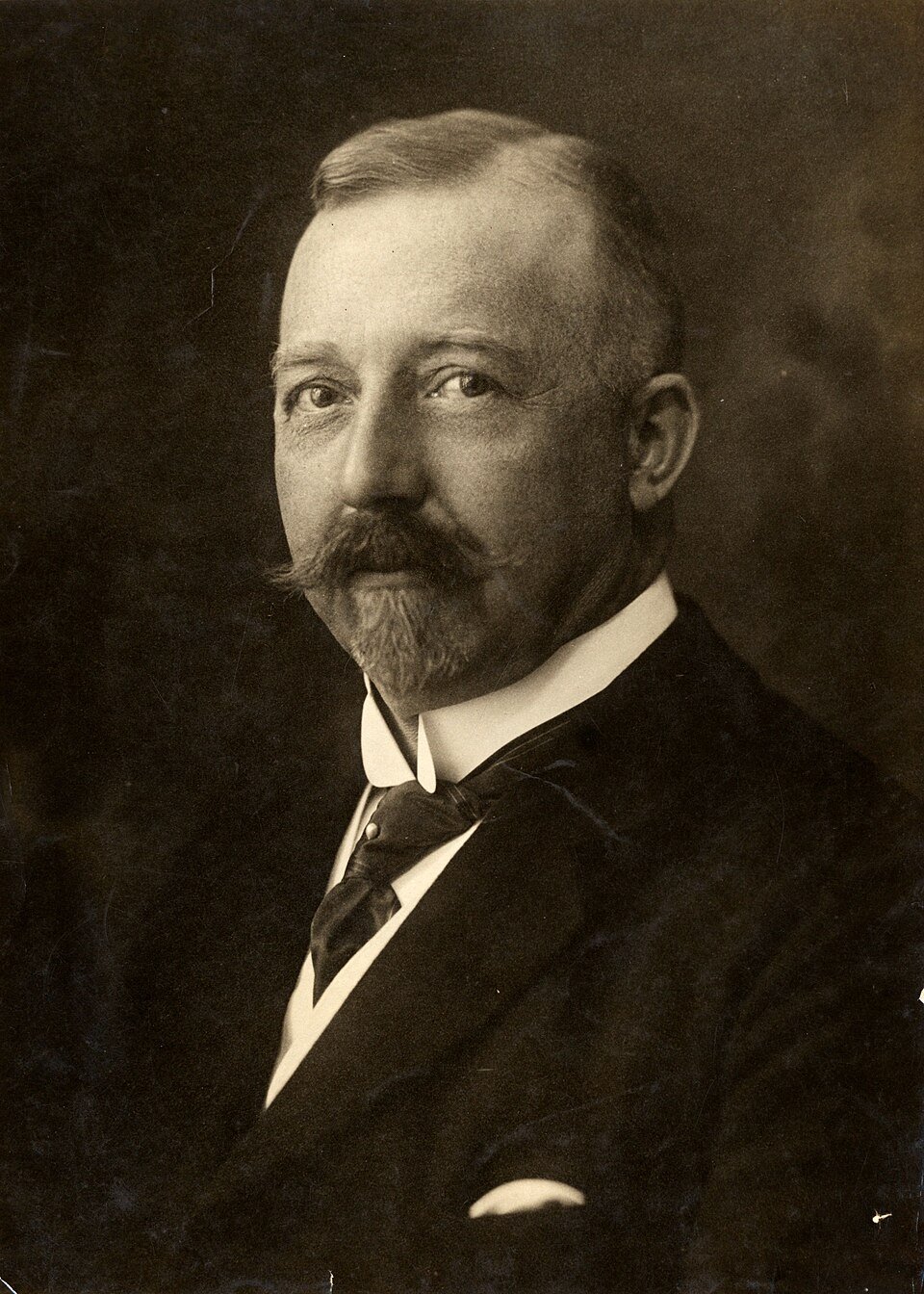
Willem de Vlugt
Twenty years as 'Father Willem': from the 1928 Olympics to his dismissal by the Germans after the February Strike.
Willem de Vlugt was born in Amsterdam on 19 December 1872, the son of a ship's carpenter. He started as a clerk at a timber merchant and in 1893 founded his own building firm, De Vlugt en Domhof, which among other things built the De Bijenkorf department store on the Damrak. A devout Protestant, he went into politics for the Anti-Revolutionary Party (ARP): parliament, the city council and from 1918 alderman for public works.
A contested appointment
He became mayor in 1921, but not without a fight. The socialist alderman Wibaut opposed him because De Vlugt had blocked his housing plans, and the provincial commissioner Röell was against him too. The cabinet backed him by a narrow majority. It became one of the longest and most prominent mayoralties in the city's history: almost twenty years. Amsterdammers called him 'Vader Willem', Father Willem.
De Vlugt was a conservative. He refused dance licences, acted against blasphemous films and plays, and called the idea of a female mayor a contradiction in terms. He was also a shrewd administrator with useful contacts in The Hague and abroad, which helped Schiphol airport and the city's shipping trade.
A stadium, a forest and a palace
He played a part in building the Olympic Stadium for the 1928 Amsterdam Olympics and was decorated after the Games. He pushed through the decision to plant a vast new forest between the Haarlemmermeer polder and the Nieuwe Meer lake: today's Amsterdamse Bos. And he had a major hand in the 1935 sale of the city hall on Dam Square, now the Royal Palace, to the national government. In 1932 the city university gave him an honorary doctorate.
There were darker moments too. In 1935 one of his sons was killed when the KLM plane De Leeuwerik crashed. In 1939 he failed to back socialist alderman De Miranda, who was wrongly accused of fraud.
February 1941
After the German invasion in 1940 De Vlugt stayed in office. In February 1941 the Germans rounded up 425 Jewish men in Amsterdam. On 25 and 26 February hundreds of thousands of Amsterdammers stopped work in protest: the February Strike. The Germans demanded that the mayor blame the Jews. De Vlugt refused, and he was dismissed as of 1 March 1941. The occupiers replaced him with a pro-German mayor.
He did not live to see the liberation. Willem de Vlugt died on 10 February 1945 in Aerdenhout, in the middle of the Hunger Winter. After the war he was reburied at De Nieuwe Ooster cemetery in Amsterdam. In the Slotermeer district, the Burgemeester De Vlugtlaan and the De Vlugtlaan metro station are named after him.
- 01De Vlugt's building firm constructed De Bijenkorf department store on the Damrak.
- 02Amsterdammers called him 'Father Willem'.
- 03He pushed through the decision to create the Amsterdamse Bos forest park.
- 04After the February Strike he refused to blame the Jews and was dismissed.
- 05The De Vlugtlaan metro station is named after him.