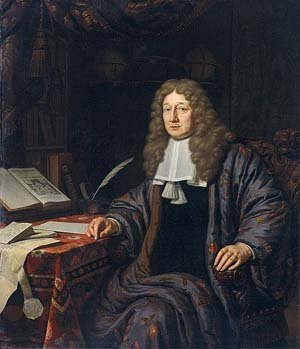
Johannes Hudde
This mathematician mayor marked the city's water levels in stone, laying the foundation for the NAP datum used across Europe.
Johannes Hudde was born in Amsterdam in 1628, the son of the merchant Gerrit Hudde and Maria Witsen. He studied law at Leiden, but there he fell under the spell of mathematics through Frans van Schooten, and it made his name across Europe.
Mathematician and lens maker
Hudde wrote on solving equations, and his "Hudde's rules" were later used by Newton and Leibniz as they developed calculus. In 1656 he published a tract on telescope lenses, and in 1663 he made microscopes with tiny spherical lenses, a few years before Antonie van Leeuwenhoek became famous for the same idea. He corresponded with Spinoza, Huygens and Leibniz, and in the early 1670s checked Johan de Witt's formulas for life annuities.
The stadtholder's man
In 1672, the "Disaster Year" when the Republic was invaded, the stadtholder William III removed part of Amsterdam's government. In September he appointed Hudde as one of the city's four burgomasters. Hudde was then chosen again almost every other year until 1703, as often as the rules allowed. Until the late 1670s he was the most powerful regent in the Republic's most powerful city, and he was also a director of the Dutch East India Company. When Leibniz visited in 1676 he found drawers full of unpublished mathematics; Hudde no longer had time for it.
Clean water and the NAP
As mayor, Hudde tackled the stinking canals. He had them flushed at high tide and had sewage from the city's cesspits diverted to pits outside town instead of into the canals. At several spots he placed stones marking the summer high-water level. These "Hudde stones" became the basis for the Normaal Amsterdams Peil, or NAP, the reference level still used across much of Europe to measure heights. He is also credited with street lighting and better fire hoses.
In 1673 he married Debora Blaeuw, which made him lord of Waveren. They had no children. Hudde died in Amsterdam on 15 April 1704.
- 01His Hudde stones became the basis for the Amsterdam water-level datum (NAP).
- 02Newton and Leibniz used his mathematical rules.
- 03He was making microscopes with spherical lenses as early as 1663.
- 04Stadtholder William III appointed him burgomaster in 1672.