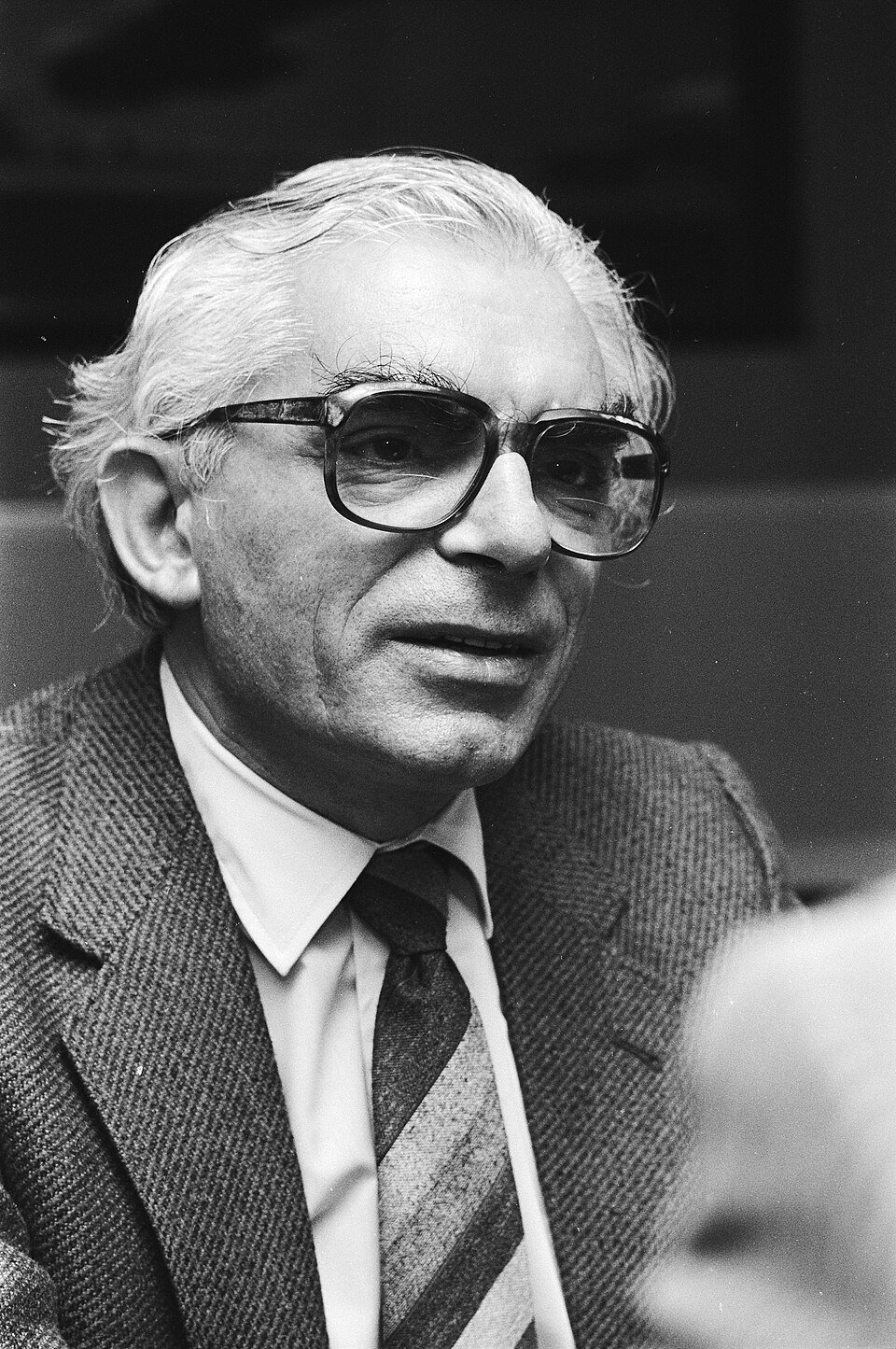
Wim Polak
The Amsterdam-born journalist who was mayor when the metro opened and the city burned on coronation day.
Wim Polak was born in Amsterdam on 14 September 1924 into a Jewish middle-class family. When Jews were barred from university during the war, he took private lessons in economics instead. In 1942 his parents were arrested and deported to Sobibor, where they were murdered. Wim went into hiding near Oldenzaal in the east of the country.
When the Twente region was liberated in April 1945, he did not celebrate: he had no idea whether his family was still alive. Single-handedly he produced the liberation edition of the newspaper De Waarheid. He went on to become economics editor at Het Vrije Volk.
From alderman to mayor
Polak joined Amsterdam's city council in 1962 and served as an alderman (a member of the city's executive) from 1965 to 1973, mainly for finance. When Mayor Samkalden fell ill, Polak stood in for him from October 1971 to March 1972. As a junior minister for the Interior he later secured more money for the big cities.
He became mayor himself on 15 June 1977. A few months later, on 14 October 1977, Amsterdam's first metro ran: Princess Beatrix and Prince Claus opened the East Line, with the first train leaving Weesperplein for Holendrecht. Building the metro and an urban road had cost almost a thousand homes.
No housing, no coronation
Housing was scarce and the squatters' movement was strong. Polak faced squatter riots and tense evictions. The climax came on 30 April 1980, the day Beatrix was inaugurated as queen. Squatters chanted 'Geen woning, geen kroning': no housing, no coronation. Fierce clashes broke out around Dam Square, at the Blauwbrug, on the Rokin and in the Vondelstraat, and buildings were set on fire. Some 10,000 police, military police and soldiers were deployed and around 600 people were injured, making it one of the biggest disturbances in the Netherlands since the war.
Polak was known as a capable administrator with an informal style, someone who looked for compromise but could act decisively when needed. He loved history, classical music and the visual arts. After his term ended on 1 June 1983 he spent ten years on the Council of State, the government's top advisory body. He received the city's gold medal and died in Ilpendam, just north of Amsterdam, on 1 October 1999.
- 01Polak's parents were arrested in 1942 and murdered at Sobibor.
- 02In April 1945 he produced the liberation edition of the newspaper De Waarheid on his own.
- 03Amsterdam's first metro ran on 14 October 1977, four months after Polak became mayor.
- 04On 30 April 1980 squatters filled the streets chanting 'no housing, no coronation'.
- 05He had already stood in as acting mayor for a few months in 1971 and 1972.