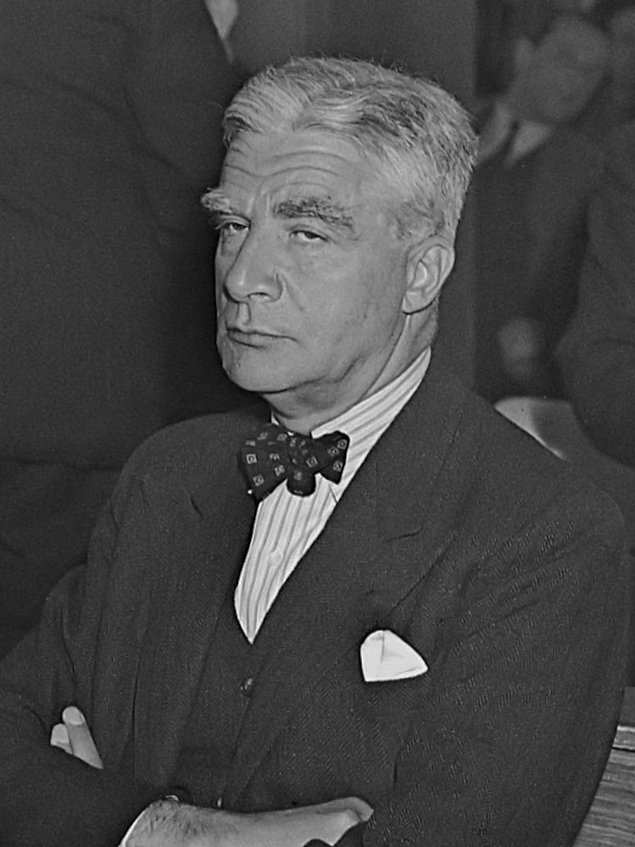
Edward Voûte
The pro-German mayor installed by the occupiers after the February Strike, and convicted after the war.
Edward Voûte was born in Amsterdam on 17 September 1887. When he was a toddler his family moved to Batavia (now Jakarta) in the Dutch East Indies. At eleven he returned to the Netherlands to live with an aunt in Arnhem and attend secondary school. He trained as a naval officer in Den Helder and served in the Royal Netherlands Navy until 1915, after which he worked as an inspector for the shipping company Koninklijke Hollandsche Lloyd.
The occupiers' mayor
In February 1941 hundreds of thousands of Amsterdammers stopped work to protest against the round-ups of Jewish men. After this February Strike, the German occupiers dismissed mayor De Vlugt and installed a pro-German city administration. Voûte was put at its head and took office on 3 March 1941. He stayed until the liberation on 5 May 1945.
These were the darkest years in the city's history. Research by the University of Amsterdam published in 2025 shows that the city government served as an instrument of German repression. The population register recorded Jewish residents, the social services department sent them to labour camps, and the municipal police, tram company and health service transported them to deportation centres and trains. Almost every German request was granted. Voûte did not take every decision himself: the Germans often gave orders directly to department heads, who acted on their own. Resistance within city hall was rare and mostly hidden.
The Hunger Winter
The final winter of the war, 1944-1945, was one of the harshest on record. In the still-occupied west of the country there was hardly any food or fuel left, and some 20,000 Dutch civilians died. In Amsterdam, hunger, deprivation and German violence killed more people than could be buried. From February to August 1945 the Zuiderkerk church served as the city morgue, as a plaque by its entrance still recalls.
After the war
After the liberation Voûte was arrested for collaborating with the Nazis. In 1946 he was sentenced to six years in prison, later reduced to three and a half years. He did not live long after his release: he died in Amsterdam on 18 June 1950. The portrait on this page was taken during his trial.
- 01Voûte was installed by the German occupiers after the February Strike.
- 02He trained as a naval officer and served in the navy until 1915.
- 03From February to August 1945 the Zuiderkerk church was the city morgue.
- 04After the war he got six years in prison, later cut to three and a half.