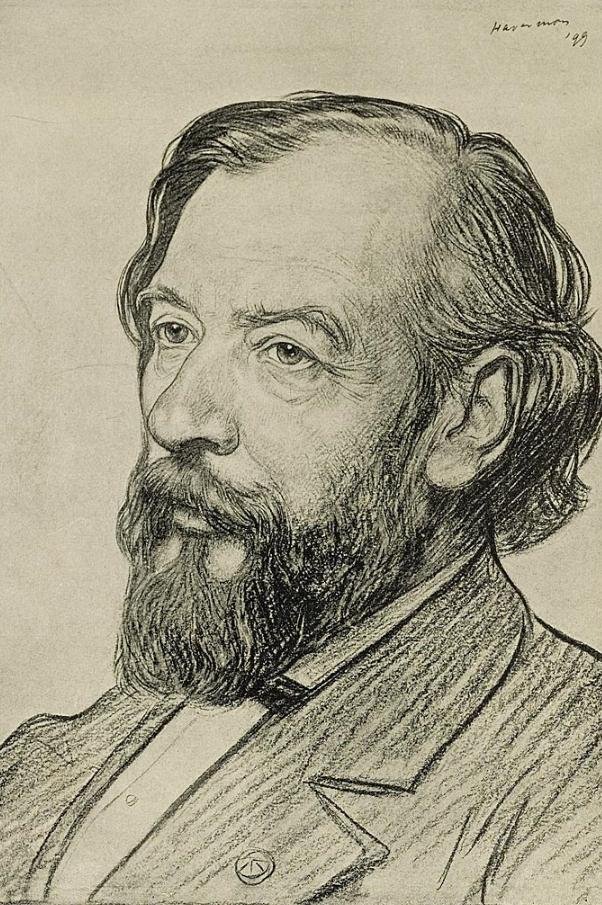
Gijsbert van Tienhoven
The mayor of the Rijksmuseum, the Concertgebouw and Central Station, and of the bloody Eel Riot.
Gijsbert van Tienhoven was born on 12 February 1841 in De Werken, near Werkendam, the eighth of thirteen children of a public works contractor. He studied law in Utrecht, led the student society there and took his doctorate in 1866. At just 28 he became a professor of law at the Athenaeum Illustre in Amsterdam. From 1874 he sat on the city council as alderman for finance, introducing a local income tax and strongly backing council-built homes for workers.
The city goes modern
On 1 January 1880 he became mayor. His eleven years coincided with Amsterdam's economic and social modernisation. In 1883 the city hosted a large international colonial and export trade exhibition. The Rijksmuseum opened in 1885, the Concertgebouw in 1888, and Central Station was also built during his term. He improved public utilities and campaigned to turn the Athenaeum Illustre into a full university. He later chaired the board of curators of the Municipal University.
Van Tienhoven was known for his exceptional tact and was often seen in the city's cultural life. Because of his dark complexion, Amsterdammers nicknamed him 'the Moroccan horseman'.
The Eel Riot
But the city grew fast and not everyone shared in the gains. In neighbourhoods such as the Kinkerbuurt, the Dapperbuurt and De Pijp, building was quick and shoddy. Van Tienhoven was more at home in high society than in working-class districts and had little time for the rising socialist movement.
On Sunday 25 July 1886 police on the Lindengracht in the Jordaan tried to stop palingtrekken, a banned folk game in which people tried to yank a live eel off a rope strung across a canal. An officer cut the rope and the crowd turned on the police. The next day a police station was besieged. At the police's request the army stepped in, and soldiers fired on the crowd. Twenty-six people died. The Eel Riot was put down with brute force on the mayor's watch.
On to The Hague
In 1891 the government asked him to form a cabinet. Van Tienhoven became foreign minister and led the cabinet until 1894, when he was the only minister to oppose dissolving parliament and resigned. From 1897 to 1911 he was the Queen's Commissioner in North Holland. He died in Bentveld on 10 October 1914. A 1933 bronze bust of him is in the University of Amsterdam's museum.
- 01Amsterdammers nicknamed Van Tienhoven 'the Moroccan horseman' for his dark complexion.
- 02The Rijksmuseum (1885) and the Concertgebouw (1888) opened during his term.
- 03Twenty-six people died in the Eel Riot of July 1886.
- 04After Amsterdam he led the national cabinet as foreign minister from 1891 to 1894.