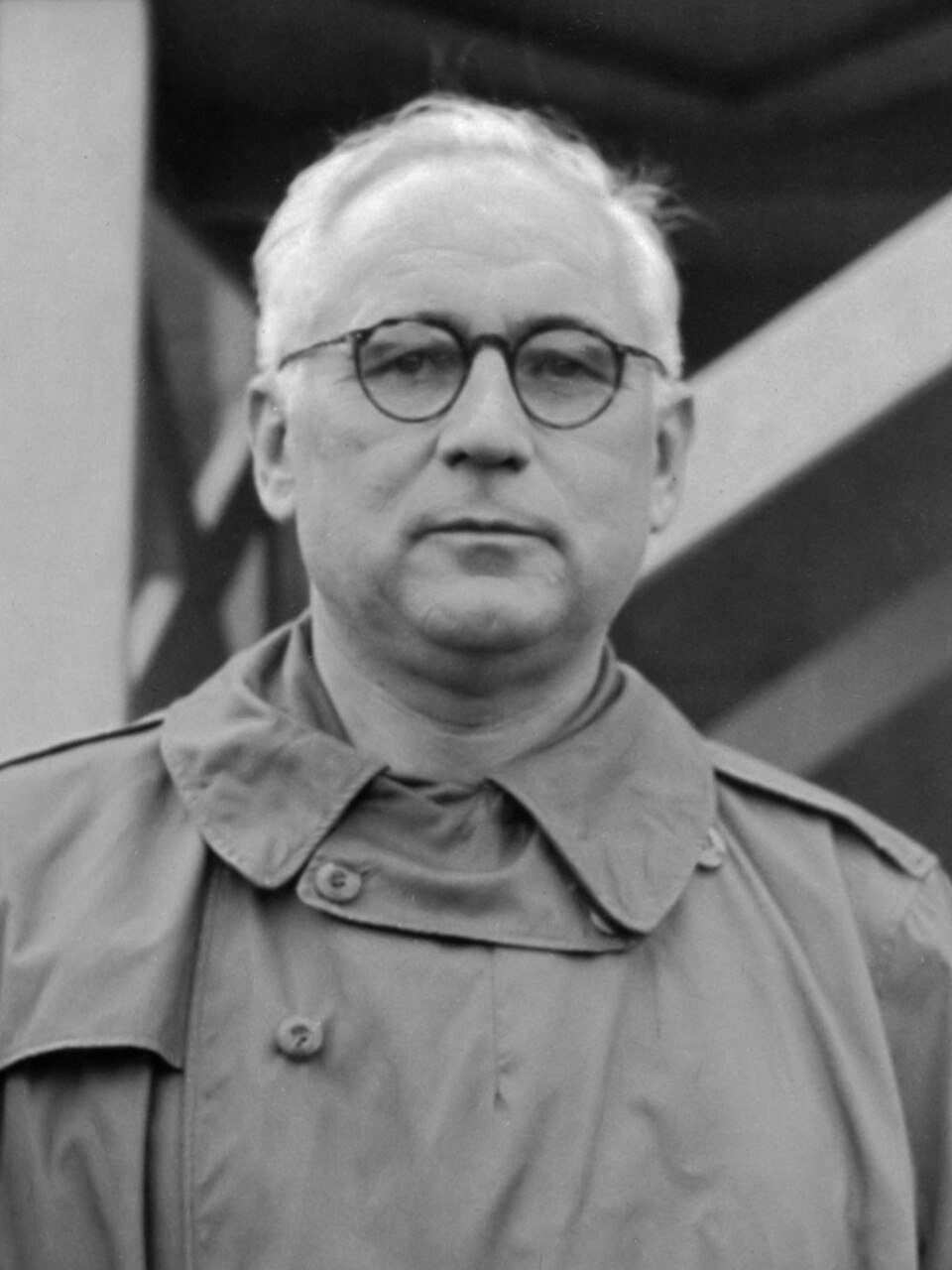
Feike de Boer
A Frisian sailor turned shipping boss who ran Amsterdam for ten months after the liberation, without any fuss.
Feike de Boer was born on 17 January 1892 in Goingarijp, a village in Friesland. His father was a farmer, landowner and member of parliament. Feike, the eldest of four brothers, chose the sea. He trained at the Royal Naval Institute in Den Helder and then served as a naval lieutenant.
Shipping boss in Batavia and Amsterdam
In 1919 he joined the Stoomvaart Maatschappij Nederland, one of Amsterdam's great shipping lines. He spent years in Batavia (now Jakarta), eventually running the company there, and in 1934 became chairman of the board in Amsterdam. He spoke many languages, including Scandinavian languages, Italian and Malay, his first wife was Danish, and his great hobby was sailing.
During the war he was active in the Amsterdam branch of the Nederlandse Unie, a mass movement of the early occupation years, and gave money to people in hiding. In January 1941 he spent three weeks in prison in Amsterdam, and in May 1942 he was held hostage in the Sint-Michielsgestel camp.
The city after liberation
On 7 May 1945, two days after the liberation, De Boer became mayor of Amsterdam. The city emerged from the war starved and exhausted. In the final months so many people had died that they could not all be buried, and until August 1945 the Zuiderkerk church served as the city morgue. De Boer's job was to get city government working again. In November 1945, under his leadership, Amsterdam got its first communist alderman, Leen Seegers.
Sources agree on his style: he ran the city without any pomp. He was very down to earth, but also authoritarian. All the while he remained chairman of his shipping company.
To Indonesia and the shipyard
He stepped down as mayor on 1 March 1946. Later that year he joined the Commission-General that negotiated with Indonesia on behalf of the Netherlands, alongside former prime minister Schermerhorn. He resigned in March 1947 because he opposed the Linggadjati Agreement and favoured military action. From 1947 to 1958 he headed the NDSM shipyard in Amsterdam. He was knighted in the Order of the Netherlands Lion in 1946 and made a commander in the Order of Orange-Nassau in 1957. Feike de Boer died in Amsterdam on 15 August 1976.
- 01Feike de Boer became mayor two days after the liberation, on 7 May 1945.
- 02He trained as a naval officer before becoming a shipping executive.
- 03In 1942 he was held hostage in the Sint-Michielsgestel camp.
- 04He later ran the NDSM shipyard in Amsterdam.
- 05He spoke Scandinavian languages, Italian and Malay, among others.