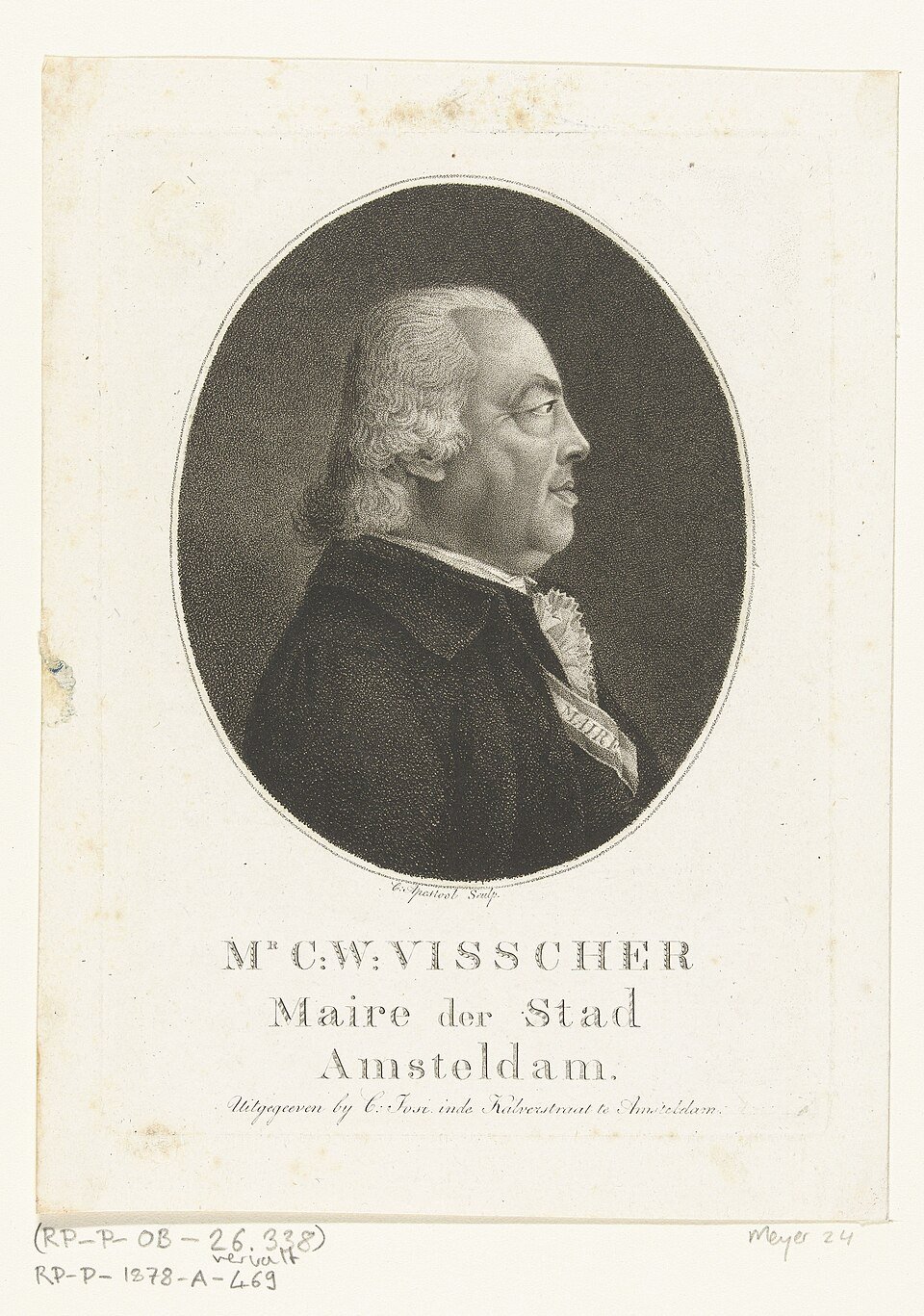
Carel Wouter Visscher
On 19 January 1795 he walked out of the Amsterdam workhouse; soon after he was leading the city.
Carel Wouter Visscher was born in Amsterdam in 1734, the son of the minister Joannes Visscher and Ida Hillegonda Valckenier. As a young lawyer he made his name with a treatise on the lawful renunciation of Philip II, the moment in 1581 when the Dutch provinces formally rejected the Spanish king. He practised as an advocate in Amsterdam and then became the city's pensionary, its chief legal adviser.
Patriot
Visscher belonged to the Patriots, the reform movement of the 1780s that wanted to curb the power of Stadtholder William V. Ordinary Patriots trusted him. After the upheaval of 1787, when Prussian troops restored the stadtholder's power, he was stripped of all his offices.
He lived quietly until 1794. That year he led a large delegation of citizens presenting a petition on the state of the country. He was arrested, sentenced to six years in prison and taken to the workhouse in Amsterdam.
The revolution of 1795
He did not stay there long. In January 1795 French troops entered the Republic. On 18 January a revolutionary committee took power in Amsterdam and William V fled the country. The old councillors were removed and a provisional government of 22 members took over. A liberty tree was raised on Dam Square. On 19 January the first French soldiers entered the city, and on that same day Visscher was released.
He was given a leading role at once, placed at the head of the Amsterdam police as maire, the French word for mayor. The Rijksmuseum, which holds a print of him, calls him maire of Amsterdam from 1795 until his death in 1802. That made him one of the first leaders of the city after more than two centuries of four ruling burgomasters. He was married to Anna Anthonia van Muiden.
- 01As a young lawyer he wrote about the renunciation of Philip II.
- 02As a Patriot he lost all his offices after 1787.
- 03In 1794 he was sentenced to six years in prison.
- 04He was freed on 19 January 1795, the day French troops entered Amsterdam.