A global spark jumps across
The Occupy movement began on 17 September 2011 in Zuccotti Park, New York. Under the name Occupy Wall Street, protesters gathered to demonstrate against the financial sector, bonus culture and social inequality. Their slogan: "We are the 99%".
The movement grew like wildfire and on 15 October 2011 actions took place all over the world, including in the Netherlands. In Amsterdam the Beursplein (the square in front of the old stock exchange) was occupied, The Hague got a camp on the Malieveld and in Utrecht a tent village sprang up on the Ganzenmarkt.
Within a few weeks there were actions in Amersfoort, Arnhem, Emmen, Enschede, Groningen, Heerenveen, Heerlen, Rotterdam, Venlo, Eindhoven and even Hendrik-Ido-Ambacht (yes, really), among other places. The wave of protest touched the whole country.
The heart of Occupy: Amsterdam
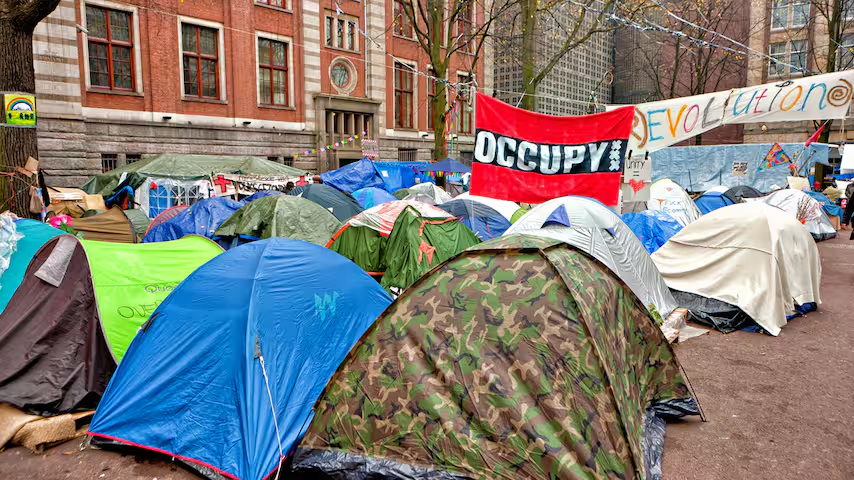
In Amsterdam, the Beursplein became the epicentre of the Dutch Occupy movement. On 15 October hundreds of people gathered, including MPs Ronald Plasterk (PvdA) and Emile Roemer (SP). The square turned into a little town full of tents, eventually around 100 of them.
People debated, ate, slept, philosophised and protested. Playful actions at the opening of the stock exchange, performances (such as Michael Franti on 22 October) and speeches by Ingeborg Beugel, among others, gave the whole thing a cultural edge.
Media, public opinion and image wreckers
Initially there was a lot of sympathy for the movement. But as the weeks passed, that changed. Various national newspapers emphasised the resulting chaos, nuisance and empty tents. In December, footage from infrared cameras also appeared, supposedly showing that 80-90% of the tents were empty.
Occupy responded with its own measurements, argued that tents were shared by several people or used for storage, and that it was mainly about the protest, not the sleeping.
The involvement of the squatters' movement and the influx of people with no other place to stay did not make the picture any clearer. In Amsterdam, people who came mainly for shelter were removed from the camp.
So what did Occupy actually want?
That's the question the movement asked itself too. There were no concrete demands or leaders. There was, however, a shared sense of injustice, frustration about the power of banks and corporations, and the feeling that society could be fairer. Occupy Amsterdam wanted precisely to arrive at a message together.
And then... it was over
On 8 December 2011 the city council began clearing part of the camp on the Beursplein. The occupation of the Shell building was ended on 27 January 2012. In the end, the court ruled on 24 March 2012 that the city council did indeed have the right to remove the activists. That same day, Occupy Amsterdam cleared up its camp.